VY Canis Majoris
What is VY Canis Majoris?
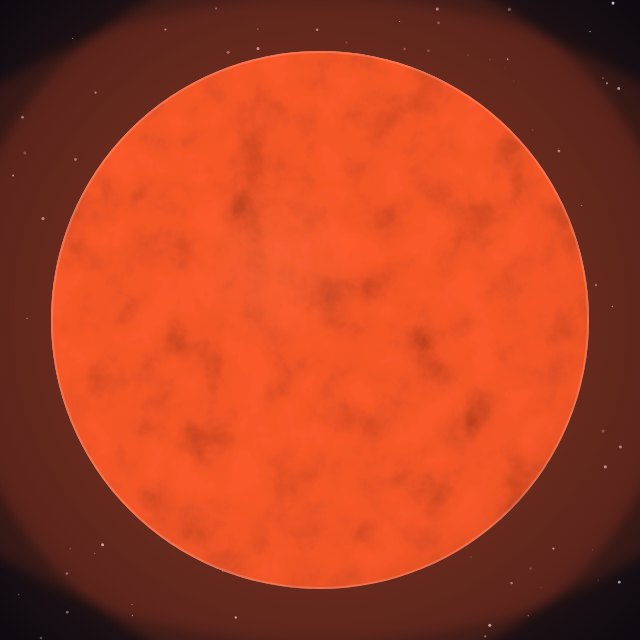
Stars· Distance ~3,900 ly · size 1,420× Sun. A red hypergiant among the largest stars known — placed where the Sun is, its surface would reach past Jupiter's orbit. It is dying in violent outbursts that shed its outer layers into a thick dust cloud; set it beside the Sun on the size ladder to grasp the scale.
📍 Visible from where you are right now — computed in your browser
bearing · altitude · rise time · best time tonight
Where VY Canis Majoris is in your sky right now: https://nowsky.org/solar/sky?sel=vy canis majoris — location and time set automatically, no login.
Stellar figures
| Distance | ~3,900 ly |
|---|---|
| Diameter | ~1,420× Sun — beyond Jupiter's orbit |
| Magnitude | varies 7–9 — telescope only |
| Constellation | Canis Major |
Figures are representative approximations. Source: compiled from NASA and IAU public data.
Frequently asked
- How far is VY Canis Majoris from Earth?
- ~3,900 ly.
- How big is VY Canis Majoris?
- ~1,420× Sun — beyond Jupiter's orbit.
- How bright is VY Canis Majoris (apparent magnitude)?
- varies 7–9 — telescope only.
- Where is VY Canis Majoris in the sky right now?
- Open the sky view for your location and time and it shows the position in the sky right now.
Eruptions in every direction, seen by ALMA
In 2021 the ALMA radio telescope mapped the motions of the material around VY Canis Majoris in three dimensions. What it found was not a wind in one direction but a series of localised eruptions — clumps thrown off from different points on the star's surface at different times, each scattering its own way. They resemble the Sun's coronal mass ejections but at billions of times the scale, some ejecting more than a thousandth of a solar mass at once.
The star loses about a thousandth of a solar mass a year, among the heaviest stellar winds known. Its surroundings are thickly wrapped in the dust it has thrown off, so it is dim in visible light and has faded noticeably over the past century. A star like this may shed most of its envelope before it explodes, and predictions differ as to whether VY Canis Majoris ends as a bright supernova or as a quiet collapse hidden in its own dust.
The star in depth
VY Canis Majoris is a red hypergiant about 3,900 light-years away in Canis Major. More than 1,400 times the Sun's diameter, it would swallow Jupiter's orbit if placed at the centre of the solar system, and it shines with roughly 270,000 solar luminosities. Its mass is estimated at around 17 Suns, and a surface of only about 3,500 K gives it its deep red hue.
The star is convulsing through the last stage of its life. Hubble images show knots and arcs of ejected gas around it, relics of repeated violent mass-loss episodes over the past few centuries. The thick dust nebula built from that lost material dims the star and makes it flicker irregularly between magnitudes 7 and 9. It will end in a supernova — possibly one that leaves a black hole.
It is invisible to the naked eye but reachable with binoculars or a small telescope south-east of Sirius. Turn on the extended-objects layer in the Sky view to mark it, then set it on the size ladder next to the Sun and Betelgeuse to feel what 'a big star' really means.
Related
Figures are representative approximations. Simulated positions use J2000 mean elements.