Stephenson 2-18
What is Stephenson 2-18?
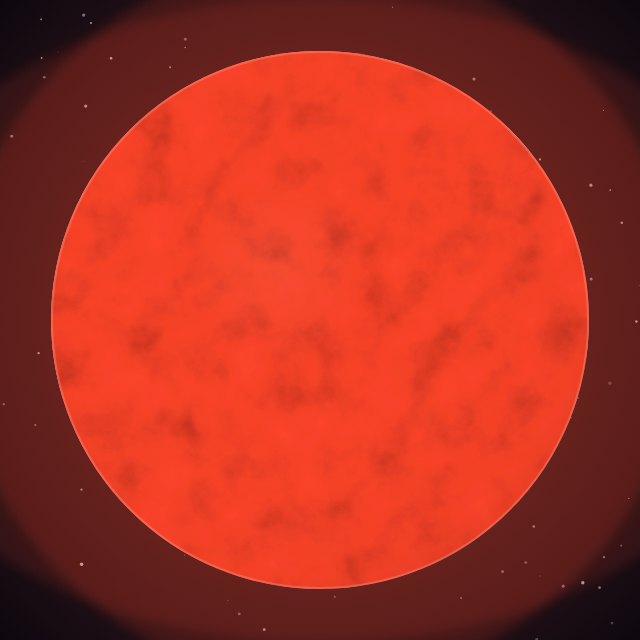
Stars· Distance ~19,000 ly · size ~2,150× Sun. The red supergiant currently ranked as the largest star known — over 2,000 Suns across, it would reach nearly to Saturn's orbit. It belongs to the young open cluster Stephenson 2 in Scutum and is so buried in dust that only infrared shows it clearly.
📍 Visible from where you are right now — computed in your browser
bearing · altitude · rise time · best time tonight
Where Stephenson 2-18 is in your sky right now: https://nowsky.org/solar/sky?sel=stephenson 2-18 — location and time set automatically, no login.
Stellar figures
| Distance | ~19,000 ly |
|---|---|
| Diameter | ~2,150× Sun — nearly to Saturn's orbit |
| Home | open cluster Stephenson 2 |
| Constellation | Scutum |
Figures are representative approximations. Source: compiled from NASA and IAU public data.
Frequently asked
- How far is Stephenson 2-18 from Earth?
- ~19,000 ly.
- How big is Stephenson 2-18?
- ~2,150× Sun — nearly to Saturn's orbit.
- In one line, what is Stephenson 2-18?
- Stars — The red supergiant currently ranked as the largest star known — over 2,000 Suns across, it would reach nearly to Saturn's orbit.
- Where is Stephenson 2-18 in the sky right now?
- Open the sky view for your location and time and it shows the position in the sky right now.
Stephenson 2, a cluster of 26 red supergiants
Stephenson 2 is a young open cluster toward Scutum, at the end of the Milky Way's central bar. About 17 million years old and holding tens of thousands of stars, it contains 26 confirmed red supergiants — among the most of any known cluster. It is a place where stars born at 15 to 25 solar masses are ageing all at once, and Stephenson 2-18 is the largest and brightest of the group.
The question is whether the star truly belongs to the cluster. Its radial velocity differs slightly from the cluster's mean and it lies away from the centre, raising the possibility that it is a foreground or background star seen in projection. If it is nearer than the cluster, its luminosity and diameter fall below the computed values and its claim to "largest star" wavers. Twenty thousand light-years away and buried in dust, it gets no help from Gaia's parallax, so its size stays "about 2,000 solar, with large uncertainty" for now.
The star in depth
Stephenson 2-18 is a red supergiant about 19,000 light-years away in Scutum, near the young open cluster Stephenson 2. Charles Stephenson found the cluster in 1990, and this star was the 18th entry in his list — hence the name. The cluster is unusually rich in red supergiants: a batch of massive stars born together and now ageing together.
An analysis published in 2020 put its diameter at about 2,150 Suns and its luminosity near 440,000 solar, earning it the current title of largest known star. By volume it could hold some ten billion Suns. Rankings among such extreme stars shift, though, because their distances and atmospheres are hard to pin down. With a surface of only about 3,200 K it radiates mostly in the infrared.
Heavily veiled by interstellar dust, it is around 15th magnitude in visible light and effectively beyond amateur telescopes. Enable the extended-objects layer in the Sky view to find its direction, then line it up on the size ladder with the Sun and UY Scuti to see what 'the largest star' really means.
Related
Figures are representative approximations. Simulated positions use J2000 mean elements.