UY Scuti
What is UY Scuti?
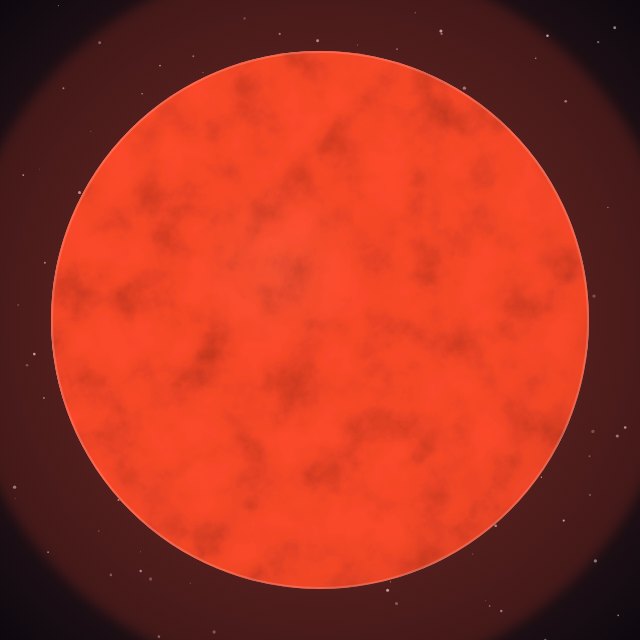
Stars· Distance ~5,000–9,500 ly · size ~1,700× Sun. A red supergiant in Scutum once billed as the largest known star. Its diameter is put at roughly 1,700 Suns, though the uncertain distance makes the figure shaky. Dust in the heart of the Milky Way dims it; set it beside the Sun on the size ladder to appreciate its volume.
📍 Visible from where you are right now — computed in your browser
bearing · altitude · rise time · best time tonight
Where UY Scuti is in your sky right now: https://nowsky.org/solar/sky?sel=uy scuti — location and time set automatically, no login.
Stellar figures
| Distance | ~5,000–9,500 ly (uncertain) |
|---|---|
| Diameter | ~1,700× Sun (large uncertainty) |
| Magnitude | ~9, variable |
| Constellation | Scutum |
Figures are representative approximations. Source: compiled from NASA and IAU public data.
Frequently asked
- How far is UY Scuti from Earth?
- ~5,000–9,500 ly (uncertain).
- How big is UY Scuti?
- ~1,700× Sun (large uncertainty).
- How bright is UY Scuti (apparent magnitude)?
- ~9, variable.
- Where is UY Scuti in the sky right now?
- Open the sky view for your location and time and it shows the position in the sky right now.
The distance Gaia changed, and the size that shrank with it
UY Scuti's title of "largest star" rested on a 2012 measurement of its angular diameter and an assumed distance of 9,500 light-years. In 2018 Gaia's parallax placed it much nearer, at about 5,100 light-years. The angular size is unchanged, so halving the distance halves the true diameter — from 1,700 to roughly 900 times the Sun's — a value that drops UY Scuti from the running for largest star.
But Gaia's parallax is less reliable for stars this big, whose disks exceed the parallax itself, so that surface brightness fluctuations shake the position measurement. UY Scuti's distance therefore remains disputed between 5,000 and 9,500 light-years, and the "about 1,700 times" in this index assumes the farther value. The rankings of hypergiants change so often not because the stars change but because the rulers do.
The star in depth
UY Scuti is a red supergiant in Scutum, set in the densest star clouds of the Milky Way. Astronomers at the Bonn Observatory first catalogued it in 1860, and its irregular brightness changes earned it the variable-star designation 'UY'. Its surface is a cool 3,400 K, yet its sheer size lets it radiate hundreds of thousands of solar luminosities.
A 2012 measurement with the VLT in Chile gave a diameter of about 1,700 Suns, and for years it was presented as the largest star known. That figure leans heavily on distance, however, and Gaia's parallax suggests the star may be closer than assumed, which would make it smaller. Either way it would extend well beyond Jupiter's orbit if placed at the Sun, and light would take hours just to circle it.
On summer nights Scutum sits above Sagittarius near the bright Milky Way star cloud; the star itself, at ninth magnitude, needs a telescope. Switch on the extended-objects layer in the Sky view to locate UY Scuti, then compare it with the other hypergiants on the size ladder.
Related
Figures are representative approximations. Simulated positions use J2000 mean elements.