Betelgeuse
What is Betelgeuse?
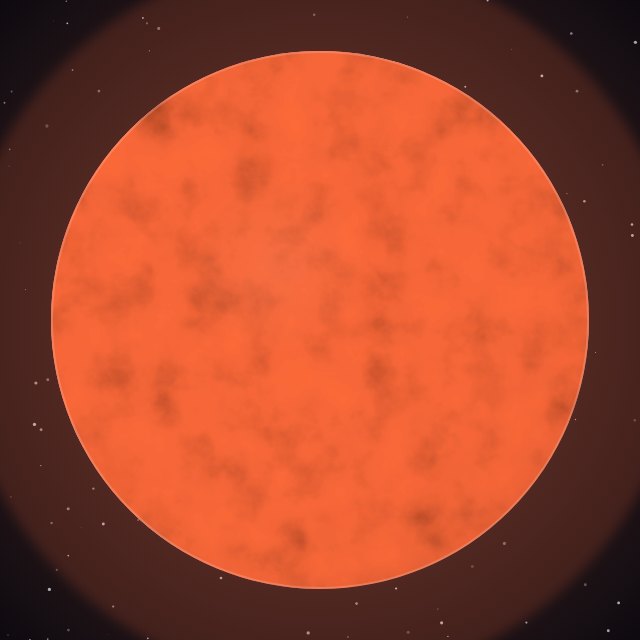
Stars· Distance ~548 ly · radius ~700× Sun. The red supergiant on Orion's shoulder — put it where the Sun is and it would swallow Jupiter's orbit. Destined to go supernova "soon" (within ~100k years).
📍 Visible from where you are right now — computed in your browser
bearing · altitude · rise time · best time tonight
Where Betelgeuse is in your sky right now: https://nowsky.org/solar/sky?sel=betelgeuse — location and time set automatically, no login.
Distance and spectral type
Betelgeuse is about 498 light-years away, a red supergiant (spectral type M2Ib), in the constellation Orion. Its apparent magnitude is 0.5, visible to the naked eye.
Stellar figures
| Distance | ~548 ly |
|---|---|
| Size | radius ~700× the Sun (est. 640–760) |
| Age | ~10 million years |
| Constellation | Orion |
| Fate | supernova within ~100k yr |
Figures are representative approximations. Source: compiled from NASA and IAU public data.
Behind the name
Its name is a garbled Arabic "hand of the giant" (often mistold as "armpit"). The Great Dimming of 2019–20 sparked supernova rumors — it was a dust cloud.
Frequently asked
- How far is Betelgeuse from Earth?
- ~548 ly.
- Which constellation is Betelgeuse in?
- Orion.
- In one line, what is Betelgeuse?
- Stars — The red supergiant on Orion's shoulder — put it where the Sun is and it would swallow Jupiter's orbit.
- Where is Betelgeuse in the sky right now?
- Open the sky view for your location and time and it shows the position in the sky right now.
The first star ever measured — Mount Wilson, 1920
On 13 December 1920 Michelson and Pease at Mount Wilson mounted a 6 m interferometer on the 2.5 m telescope and measured the diameter of Betelgeuse: 0.047 arcseconds, which at the distance then assumed meant 300 times the Sun's diameter, large enough to swallow the orbit of Mars. It was the first time the size of any star but the Sun had been measured directly, and the next day's newspapers put "star measured" on the front page.
Betelgeuse was the first target because, large and near, it has the biggest angular diameter of any star. A century on it is still one of the few stars whose surface can be imaged, and during the Great Dimming of 2019–2020 ESO's Very Large Telescope photographed the southern part of the disk going dark. The present estimate is around 700 solar diameters, but the star's edge is fuzzy and the value changes with wavelength — the enduring difficulty of measuring this star.
The star in depth
Betelgeuse is Orion's red shoulder — a supergiant that, placed at the Sun's position, would swallow Jupiter's orbit, some 700 solar radii across. It is roughly 10 million years old: stars born big die young and loud.
Its 2019 "Great Dimming" to a third of normal brightness sparked supernova rumors; the culprit appears to be a dust cloud of its own making combined with a drop in surface temperature. In 2025 the Gemini North telescope reported the first direct image of the long-suspected companion star. The ending is still written, though — within tens of millennia it will explode, shining like a half moon, visible in daylight.
At 548 light-years, the blast poses no danger. Find it in Orion in the Sky view: the light you see left during the Joseon dynasty.
When Betelgeuse abruptly dimmed in late 2019, 'supernova imminent' headlines flew — the culprit appears to be a dust cloud the star itself had belched, together with a cooling of its surface, briefly veiling its light. When it does blow, it will shine like a half moon for months, visible in daylight, yet harmless at 548 light-years. And since tonight's light left 548 years ago, it may — logically — have already happened.
Related
Figures are representative approximations. Simulated positions use J2000 mean elements.