Sirius
What is Sirius?
Stars· Distance 8.6 ly · size 1.7× Sun. The brightest star in the night sky — twice the Sun's mass, 25× its light, with a white-dwarf companion. Find it blazing blue-white on winter nights.
📍 Visible from where you are right now — computed in your browser
bearing · altitude · rise time · best time tonight
Where Sirius is in your sky right now: https://nowsky.org/solar/sky?sel=sirius — location and time set automatically, no login.
Distance and spectral type
Sirius is about 9 light-years away, a white star (spectral type A0m...), in the constellation Aquila. Its apparent magnitude is -1.5, visible to the naked eye.
Stellar figures
| Distance | 8.6 ly |
|---|---|
| Magnitude | −1.46 — brightest star |
| Constellation | Canis Major |
Figures are representative approximations. Source: compiled from NASA and IAU public data.
Behind the name
Greek "scorching". Ancient Egypt timed the Nile flood and the new year by its dawn rising.
Frequently asked
- How far is Sirius from Earth?
- 8.6 ly.
- How bright is Sirius (apparent magnitude)?
- −1.46 — brightest star.
- Which constellation is Sirius in?
- Aquila.
- Where is Sirius in the sky right now?
- Open the sky view for your location and time and it shows the position in the sky right now.
Was Sirius red? A puzzle in ancient records
In the Almagest, around AD 150, Ptolemy classed Sirius among the red stars; Seneca, Cicero and Horace also described it as red or fiery. Today Sirius is unmistakably blue-white, and the discrepancy was argued over for a long time — if a star's colour had changed in two thousand years, the theory of stellar evolution would be wrong.
Explanations abound: that the writers recorded Sirius flashing red near the horizon through atmospheric refraction; that "red" was rhetoric for brightness; that the light dated from a time when the companion Sirius B was a red giant (which fails, since B became a white dwarf a hundred million years ago). In the same era China's Sima Qian recorded Sirius as white. The prevailing conclusion is that the problem lies in the texts, not the star.
The star in depth
Sirius is the brightest star in the night sky — not because it is a giant, but because it is close: 8.6 light-years, next door by cosmic standards. Twice the Sun's mass, 25 times its light, blazing blue-white on winter evenings.
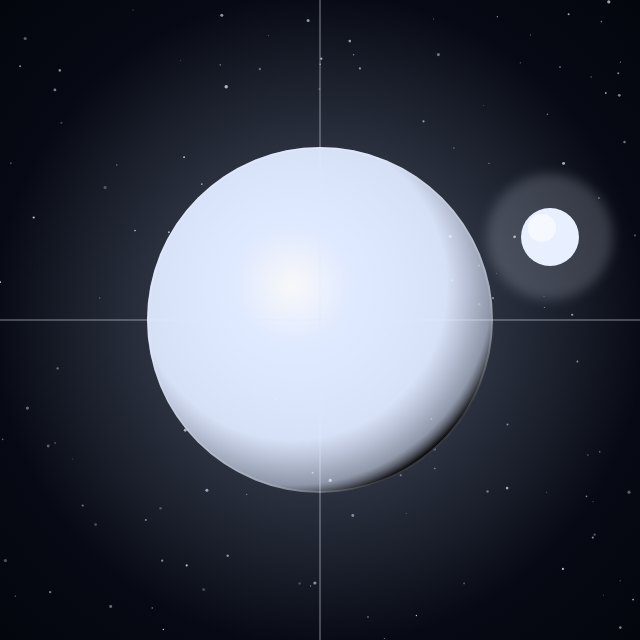
Beside it drifts a ghost: Sirius B, the burned-out core of a star once heavier than Sirius A — a white dwarf packing a full solar mass into an Earth-sized ball, where a sugar cube weighs about a tonne.
Ancient Egypt set its calendar by Sirius's first dawn rising, which foretold the Nile flood — the star of the human calendar. Find it in Canis Major in the Sky view.
Sirius B's discovery is its own drama: in 1844 Bessel noticed Sirius wobbling as if tugged by an unseen companion, and 18 years later telescope-maker Alvan Clark caught it while testing a new lens. Its gravity is so fierce that light climbing away gets stretched — one of the first measurements of gravitational redshift, an early test of general relativity.
Related
Figures are representative approximations. Simulated positions use J2000 mean elements.