Vega
What is Vega?
Stars· Distance 25 ly · size 2.4× Sun. The brilliant summer zenith star. Thanks to Earth's axial precession, Vega will be the pole star ~12,000 years from now.
📍 Visible from where you are right now — computed in your browser
bearing · altitude · rise time · best time tonight
Where Vega is in your sky right now: https://nowsky.org/solar/sky?sel=vega — location and time set automatically, no login.
Distance and spectral type
Vega is about 25 light-years away, a white main-sequence star (spectral type A0Vvar), in the constellation Cygnus. Its apparent magnitude is 0, visible to the naked eye.
Stellar figures
| Distance | 25 ly |
|---|---|
| Constellation | Lyra |
| Note | the pole star in ~12,000 yr |
Figures are representative approximations. Source: compiled from NASA and IAU public data.
Behind the name
Arabic "the swooping eagle". It defined magnitude zero and was the first star ever photographed (1850).
Frequently asked
- How far is Vega from Earth?
- 25 ly.
- What is notable about Vega?
- the pole star in ~12,000 yr.
- Which constellation is Vega in?
- Cygnus.
- Where is Vega in the sky right now?
- Open the sky view for your location and time and it shows the position in the sky right now.
Once around in 12 hours — a flattened star seen pole-on
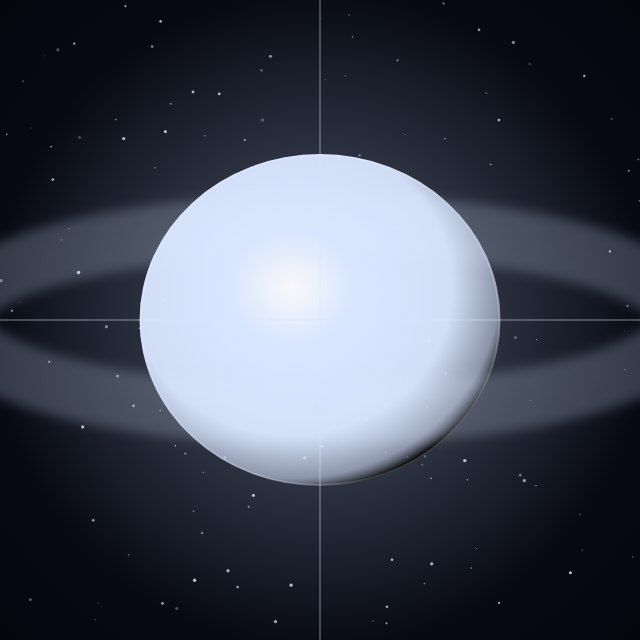
Vega rotates once every 12.5 hours — fifty times faster than the Sun's 25 days — with an equatorial speed of 236 km/s, 90 percent of the rate at which the star would fly apart. Its equator bulges 19 percent wider than its poles, and the bulging equator is 2,000 degrees cooler than the poles. We happen to look down on it nearly pole-on, so its disk appears round, but from the side it would be a clear ellipse.
This was confirmed by interferometry in 2006; until then Vega was taken for a slowly rotating standard star, because viewed pole-on the rotation shows no component along the line of sight and spectroscopy caught no speed. After the discovery that the reference star of the magnitude system was in fact an unusual one, Vega's brightness and temperature carry the caveat that they describe its hot polar face.
The star in depth
Vega is the brilliant zenith star of summer nights — a blue-white star 25 light-years away, anchoring the Summer Triangle with Deneb and Altair, and starring opposite Altair in the East Asian tale of the weaver and the herder.
Historically Vega is the reference star: the magnitude scale was long calibrated with Vega at zero, it was the first star (after the Sun) ever photographed (1850), and the 1983 discovery of its dust disk opened the study of other planetary systems.
Earth's axis wobbles like a top every 26,000 years — in about 12,000 years it will point at Vega, the pole star of our descendants. Find it in Lyra in the Sky view.
Vega has long served as astronomy's ruler: the zero-point of the magnitude scale, the first star ever photographed (1850), and in 1983 the star around which an infrared satellite found a dusty debris disk — opening the study of other planetary systems. It's no accident Carl Sagan chose Vega as the source of the signal in Contact.
Related
Figures are representative approximations. Simulated positions use J2000 mean elements.