Vela Pulsar
What is Vela Pulsar?
Neutron stars & pulsars· Distance ~1,000 ly. The pulsar left by a star that exploded about 11,000 years ago. It is among the brightest gamma-ray sources in the sky and the most frequently "glitching" pulsar known — found toward Vela in the southern sky.
📍 Visible from where you are right now — computed in your browser
bearing · altitude · rise time · best time tonight
Where Vela Pulsar is in your sky right now: https://nowsky.org/solar/sky?sel=vela pulsar — location and time set automatically, no login.
Its place in the sky
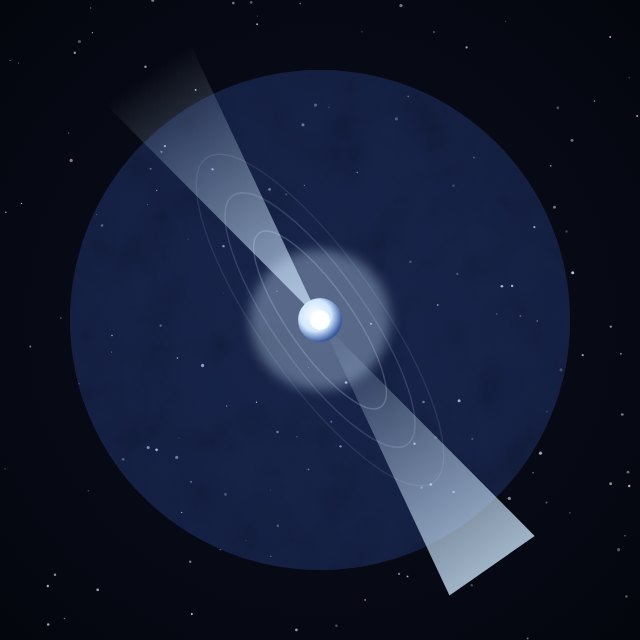
A pulsar, in the direction of Vela.
Spin, distance, discovery
| Type | radio and gamma-ray pulsar in the Vela supernova remnant |
|---|---|
| Spin period | 89 ms (about 11 turns a second) |
| Distance | ~960–1,000 ly |
| Discovered | 1968 with the Molonglo radio telescope, Australia |
Figures are representative approximations. Source: compiled from NASA and IAU public data.
Discovery and name
The pulsar in a 10,000-year-old remnant, spinning 11 times a second and one of the few visible in optical light.
Frequently asked
- What kind of object is Vela Pulsar?
- radio and gamma-ray pulsar in the Vela supernova remnant.
- How long is the orbital period of Vela Pulsar?
- 89 ms (about 11 turns a second).
- How far is Vela Pulsar from Earth?
- ~960–1,000 ly.
- When was Vela Pulsar discovered?
- 1968 with the Molonglo radio telescope, Australia.
- Where in the sky is Vela Pulsar?
- In the direction of Vela.
- Where is Vela Pulsar in the sky right now?
- Open the sky view for your location and time and it shows the position in the sky right now.
In 2016 a glitch was caught as it happened
The Vela pulsar glitches — its spin suddenly speeds up — once every few years, but for a long time no one had watched one happen. With no way to know when a glitch will come, catching one in the act is a matter of luck. On 12 December 2016 a team that had monitored the pulsar almost daily for more than three years with the Mount Pleasant radio telescope in Australia finally recorded the individual pulses across the moment of a glitch.
In the data one pulse just before the glitch was unusually broad, the next all but vanished, and the spin then continued at its faster rate. It was the first direct view showing that the transfer of angular momentum from the superfluid interior to the crust is over within seconds, and that the star's magnetosphere is affected in those seconds too. For a neutron star, whose interior cannot be seen, the record of that moment is one of the few windows for testing its inner structure.
The neutron star in depth
The Vela Pulsar is the neutron star at the center of the remnant of a supernova that went off toward Vela about 11,000 years ago. It turns roughly 11 times a second, pulsing in radio every 89 milliseconds, and in gamma rays it ranks among the brightest steady sources in the sky. At about 1,000 light-years it is one of the nearer pulsars known, close enough that the thread-like filaments of its remnant are mapped in detail.
It was found in 1968 with the Molonglo radio telescope in Australia, and optical pulses confirmed in 1977 made it only the second pulsar, after the Crab, seen flashing in visible light. What made it famous are its "glitches" — sudden jumps in spin rate every few years — recorded more than twenty times since the first in 1969, turning it into the standard object for studying how the superfluid inside a neutron star hands angular momentum to the crust.
Vela is a southern constellation, so from Korea the pulsar spends much of its time below the horizon; in the Sky view, move the observer to Sydney or Cape Town and select the Vela Pulsar to see exactly where it lies. The nearby-stars 3D view also places it among the Sun's stellar neighbors, showing its direction and distance.
Related
Figures are representative approximations. Simulated positions use J2000 mean elements.