Crab Pulsar
What is Crab Pulsar?
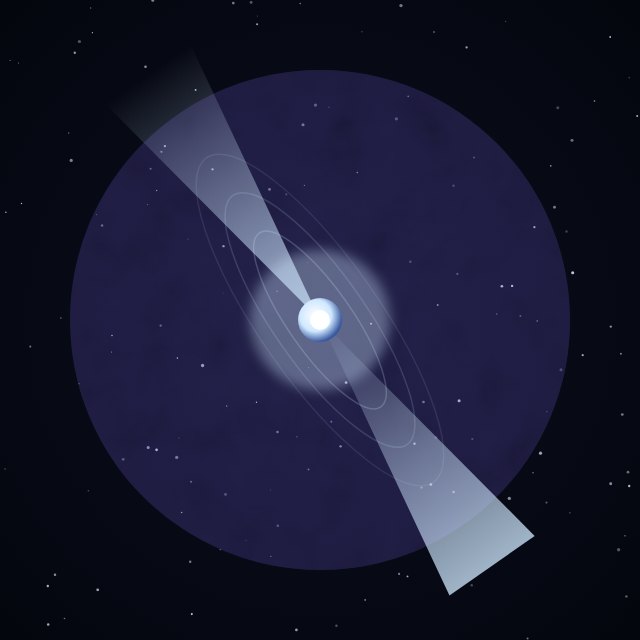
Neutron stars & pulsars· Distance 6,500 ly. The heart left behind by the supernova of 1054, bright enough to be seen in daylight. A neutron star barely 20 km across spins 30 times a second, sweeping beams like a lighthouse and powering the whole Crab Nebula. Find it at the nebula's position in Taurus in the Sky view.
📍 Visible from where you are right now — computed in your browser
bearing · altitude · rise time · best time tonight
Where Crab Pulsar is in your sky right now: https://nowsky.org/solar/sky?sel=crab nebula — location and time set automatically, no login.
Its place in the sky
A pulsar, in the direction of Taurus, spanning about 6 arcminutes of sky — 0.2 times the width of the full Moon.
Spin, distance, discovery
| Type | radio, optical and X-ray pulsar at the heart of a supernova remnant |
|---|---|
| Spin period | 33.4 ms (about 30 turns a second) |
| Distance | ~6,500 ly |
| Discovered | 1968 as a radio pulsar; the parent supernova was seen in 1054 |
Figures are representative approximations. Source: compiled from NASA and IAU public data.
Discovery and name
Remains of the "guest star" of 1054 recorded in China and Arabia; Messier mistook it for a comet and made it his No. 1.
Frequently asked
- What kind of object is Crab Pulsar?
- radio, optical and X-ray pulsar at the heart of a supernova remnant.
- How long is the orbital period of Crab Pulsar?
- 33.4 ms (about 30 turns a second).
- How far is Crab Pulsar from Earth?
- ~6,500 ly.
- When was Crab Pulsar discovered?
- 1968 as a radio pulsar; the parent supernova was seen in 1054.
- Where in the sky is Crab Pulsar?
- In the direction of Taurus.
- Where is Crab Pulsar in the sky right now?
- Open the sky view for your location and time and it shows the position in the sky right now.
The star that became a unit of X-ray astronomy — the millicrab
The Crab Nebula and its pulsar are the brightest and, for a long time, the most nearly constant object in the X-ray sky, so X-ray astronomers record the brightness of other sources by comparison with it. The nebula's X-ray brightness is defined as one crab, and a thousandth of that is a millicrab. A source of "20 millicrab" is two percent as bright as the Crab, and the unit lets satellites with different detectors be compared.
In 2011, however, Fermi and other satellites found that the Crab's high-energy brightness had drifted by about seven percent over a few years and that its gamma rays occasionally leap several-fold in flares lasting days, unsettling the assumption of an unchanging standard candle. The flares are read as magnetic fields in the pulsar wind reconnecting and accelerating electrons. The star that served as the sky's ruler turned out to waver itself.
The neutron star in depth
The Crab Pulsar is what remains of the supernova that Song dynasty astronomers logged in July 1054 as a "guest star" visible in daylight. The core of the exploded star was crushed into a neutron star roughly 20 km across yet 1.4 times the Sun's mass, and it still spins about 30 times a second, emitting pulses every 33 milliseconds across radio, visible, X-ray and gamma-ray wavelengths. That rotational energy keeps the surrounding Crab Nebula glowing to this day.
Radio pulses were detected in 1968, settling the case that pulsars are neutron stars born in supernovae, and the next year it became the first pulsar seen flashing in visible light. Its spin slows by about 38 nanoseconds a day; that braking rate implies an energy output around 100,000 times the Sun's. Occasional "glitches", sudden speed-ups of the rotation, make it a standard laboratory for the superfluid interior of neutron stars.
In the Sky view, select the Crab Nebula near the tip of Taurus's horn to see where the pulsar sits. Small telescopes show only the faint nebula and the 16th-magnitude pulsar needs a large instrument, but simply locating the nebula in the southern winter sky puts you face to face with the scar of an explosion that lit the daytime sky a thousand years ago.
Related
Figures are representative approximations. Simulated positions use J2000 mean elements.