PSR B1919+21
What is PSR B1919+21?
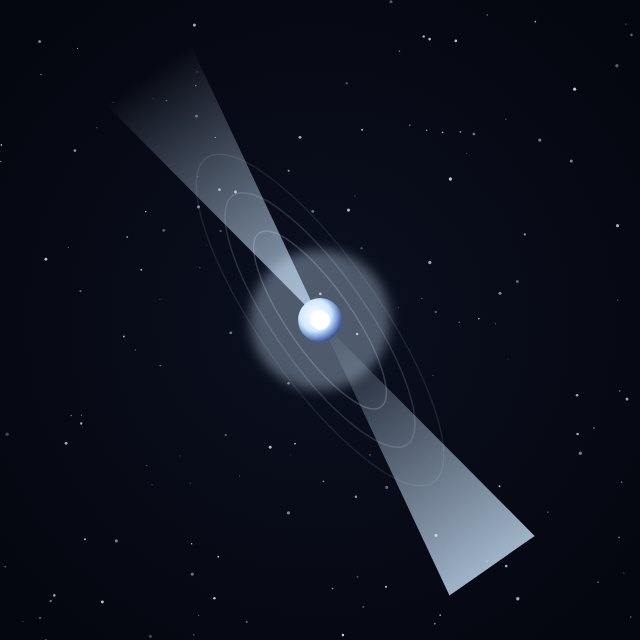
Neutron stars & pulsars· Distance ~2,300 ly. The first pulsar ever found, spotted in 1967 by Cambridge graduate student Jocelyn Bell Burnell on a strip-chart recording. Its signal repeating every 1.3373 seconds was so regular it was jokingly labeled LGM-1, "little green men". It lies in Vulpecula.
📍 Visible from where you are right now — computed in your browser
bearing · altitude · rise time · best time tonight
Where PSR B1919+21 is in your sky right now: https://nowsky.org/solar/sky?sel=psr b1919 — location and time set automatically, no login.
Its place in the sky
A pulsar, in the direction of Vulpecula.
Spin, distance, discovery
| Type | radio pulsar — the first ever discovered |
|---|---|
| Spin period | 1.3373 s |
| Distance | ~2,300 ly |
| Discovered | 28 Nov 1967 by Jocelyn Bell Burnell, Cambridge |
Figures are representative approximations. Source: compiled from NASA and IAU public data.
Discovery and name
Found in 1967 by grad student Jocelyn Bell; so regular it was jokingly dubbed LGM-1 (Little Green Men). The Nobel went to her supervisor.
Frequently asked
- What kind of object is PSR B1919+21?
- radio pulsar — the first ever discovered.
- How long is the orbital period of PSR B1919+21?
- 1.3373 s.
- How far is PSR B1919+21 from Earth?
- ~2,300 ly.
- When was PSR B1919+21 discovered?
- 28 Nov 1967 by Jocelyn Bell Burnell, Cambridge.
- Where in the sky is PSR B1919+21?
- In the direction of Vulpecula.
- Where is PSR B1919+21 in the sky right now?
- Open the sky view for your location and time and it shows the position in the sky right now.
The pulses that became an album cover — a graph from 1979
One graph of stacked pulses from PSR B1919+21 escaped into the world outside science. Drawn in 1970 by Harold Craft, a graduate student at Cornell, from Arecibo data — eighty pulses stacked vertically — it appeared in the Cambridge Encyclopaedia of Astronomy, and in 1979 the British band Joy Division used it as the cover of their first album. White mountain-range lines on a black ground, the cover was reproduced on shirts and posters for decades afterward.
Each line is one pulse arriving every 1.337 seconds, and the lines differ slightly because the pulsar's beam is never quite the same twice. The cover carries no star name or caption, so many people have looked at it without knowing what it shows. The first pulsar humanity found began as a radio signal and became an icon of design, while the star itself keeps the same beat, unchanged, in Vulpecula.
The neutron star in depth
PSR B1919+21 is the first pulsar ever detected, found on 28 November 1967 by Cambridge graduate student Jocelyn Bell Burnell while combing through strip-chart recordings. A signal repeating every 1.3373 seconds seemed far too regular to be natural, so the team half-jokingly labeled it LGM-1 for "little green men"; more objects of the same kind soon turned up, and the explanation as rapidly rotating neutron stars quickly took hold.
The discovery earned her supervisor Antony Hewish the 1974 Nobel Prize in Physics, while Bell Burnell, who actually found the signal, was left out — a controversy that still echoes through the history of science. In 2018 she received a Special Breakthrough Prize and gave the entire award to scholarships for under-represented physics students. The pulsar's radio pulse profile also became a pop-culture icon as the cover of Joy Division's album "Unknown Pleasures".
Vulpecula is a faint constellation in the heart of the summer Milky Way, between Cygnus and Sagitta. Select PSR B1919+21 in the Sky view and you will be looking at a spot where nothing is visible to the eye, yet a star turns like a lighthouse once a second. On summer evenings look overhead near Albireo.
Related
Figures are representative approximations. Simulated positions use J2000 mean elements.