PSR J0437−4715
What is PSR J0437−4715?
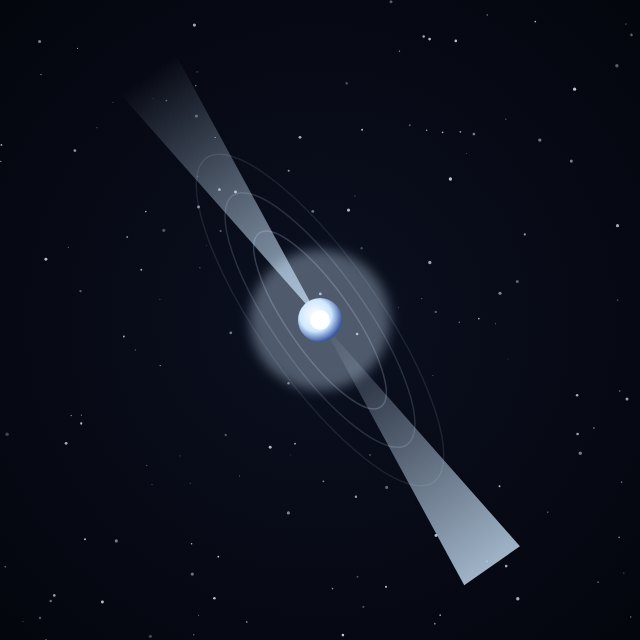
Neutron stars & pulsars· Distance ~510 ly. The nearest millisecond pulsar, spinning 174 times a second. Matter pulled from its companion spun it up to this extreme, and its ticks rival atomic clocks. In 2024 NASA's NICER measured its diameter at about 23 km, making it the benchmark for neutron-star size. It lies in Pictor.
📍 Visible from where you are right now — computed in your browser
bearing · altitude · rise time · best time tonight
Where PSR J0437−4715 is in your sky right now: https://nowsky.org/solar/sky?sel=psr j0437 — location and time set automatically, no login.
Its place in the sky
A pulsar, in the direction of Caelum.
Spin, distance, discovery
| Type | millisecond pulsar in a binary with a white dwarf |
|---|---|
| Spin period | 5.757 ms (174 turns a second) |
| Distance | ~510 ly, the nearest millisecond pulsar |
| Orbit | 5.74 days with its white-dwarf companion |
| Discovered | 1993 with the Parkes radio telescope |
Figures are representative approximations. Source: compiled from NASA and IAU public data.
Discovery and name
Found in 1993 — the nearest, brightest millisecond pulsar, spinning 174 times a second as a cosmic clock.
Frequently asked
- What kind of object is PSR J0437−4715?
- millisecond pulsar in a binary with a white dwarf.
- How long is the orbital period of PSR J0437−4715?
- 5.757 ms (174 turns a second).
- How far is PSR J0437−4715 from Earth?
- ~510 ly, the nearest millisecond pulsar.
- When was PSR J0437−4715 discovered?
- 1993 with the Parkes radio telescope.
- Where in the sky is PSR J0437−4715?
- In the direction of Caelum.
- Where is PSR J0437−4715 in the sky right now?
- Open the sky view for your location and time and it shows the position in the sky right now.
One of the clocks that heard the gravitational-wave background
In June 2023 pulsar timing arrays around the world announced together evidence of a gravitational-wave background filling the universe. They had timed the pulse arrivals of dozens of millisecond pulsars across the galaxy for more than fifteen years and found a pattern in which those times wobbled in subtle correlation. PSR J0437-4715, the nearest, brightest and most precisely timed pulsar in the arrays, was one of the pillars of the measurement.
The detected background lies in the nanohertz band, gravitational waves with wavelengths of several light-years, read as the overlapping hum of pairs of galactic-centre black holes merging throughout the universe — a frequency a billion times lower than what ground detectors hear. This pulsar in Pictor, using its 174 rotations a second as a clock, serves as one arm of a detector the size of the galaxy.
The neutron star in depth
PSR J0437-4715, about 510 light-years away toward Pictor, is the nearest millisecond pulsar to Earth. It completes a turn every 5.757 milliseconds — 174 times a second — and circles a white-dwarf companion every 5.74 days. It is the textbook "recycled pulsar": an old neutron star spun back up by angular momentum carried in with matter from its companion, a spin that then stays almost unchanged for hundreds of millions of years.
Found in a 1993 survey with the Parkes radio telescope in Australia, it became the most precisely timed pulsar known, its pulse arrival times predictable to the nanosecond. That precision made it a cornerstone of pulsar timing arrays worldwide, which used it to help detect the ultra-low-frequency gravitational-wave background that pervades the galaxy. In 2024 NASA's NICER X-ray instrument tracked hot spots on its surface to measure a diameter of about 23 km and a mass of 1.4 Suns, setting the benchmark for neutron-star size.
Pictor is a southern constellation beside Canopus and never rises over Korea. In the Sky view, move the observer to Sydney or Santiago and select PSR J0437-4715 to see where this pulsar sits next to Canopus, the sky's second-brightest star. Nothing shows to the eye, yet from that spot 174 pulses a second are arriving at Earth.
Related
Figures are representative approximations. Simulated positions use J2000 mean elements.