Geminga
What is Geminga?
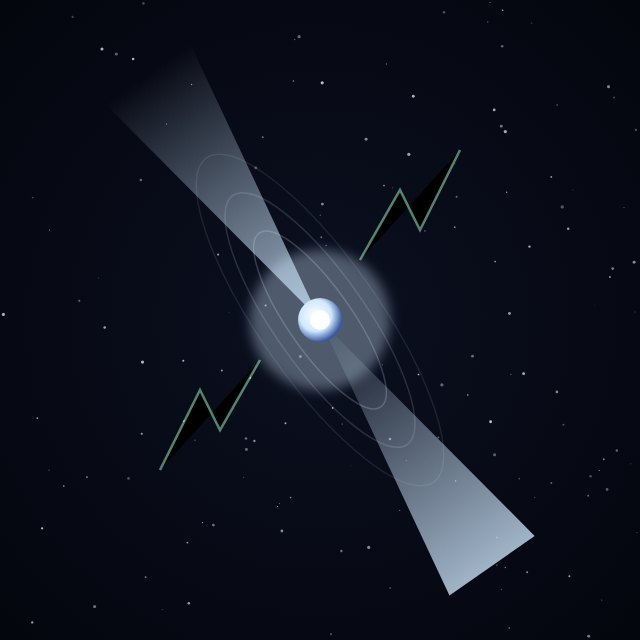
Neutron stars & pulsars· Distance ~800 ly. A star nearly silent in radio that shines almost only in gamma rays. For twenty years its identity was a mystery, earning a name from Milanese dialect meaning "it isn't there". At about 800 light-years it is one of the closest pulsars, near Pollux in Gemini.
📍 Visible from where you are right now — computed in your browser
bearing · altitude · rise time · best time tonight
Where Geminga is in your sky right now: https://nowsky.org/solar/sky?sel=geminga — location and time set automatically, no login.
Its place in the sky
A pulsar, in the direction of Gemini.
Spin, distance, discovery
| Type | gamma-ray and X-ray pulsar, nearly radio-quiet |
|---|---|
| Spin period | 237 ms |
| Distance | ~800 ly |
| Discovered | 1972 as a gamma-ray source (SAS-2); pulsations found in 1992 |
Figures are representative approximations. Source: compiled from NASA and IAU public data.
Discovery and name
A gamma-ray source of 1972 that stayed unidentified for 20 years — named from Milanese dialect "it's not there".
Frequently asked
- What kind of object is Geminga?
- gamma-ray and X-ray pulsar, nearly radio-quiet.
- How long is the orbital period of Geminga?
- 237 ms.
- How far is Geminga from Earth?
- ~800 ly.
- When was Geminga discovered?
- 1972 as a gamma-ray source (SAS-2); pulsations found in 1992.
- Where in the sky is Geminga?
- In the direction of Gemini.
- Where is Geminga in the sky right now?
- Open the sky view for your location and time and it shows the position in the sky right now.
Was this the explosion that made the bubble around the solar system?
The solar system sits inside the Local Bubble, a hot, thin cavity 300 light-years across, carved out of the interstellar gas by several supernovae that exploded nearby over the past few million years. Geminga is one of the candidates. It is about 300,000 years old and 800 light-years away, and tracing its proper motion backward puts the site of its explosion closer to the solar system than it is now.
The hypothesis is not settled. The Local Bubble appears older than Geminga, and the supernovae of the Scorpius–Centaurus association are more often cited as the main cause. Still, as one of the nearest pulsars to Earth, Geminga may well have left its mark on the interstellar surroundings of the Sun. This faint star in Gemini is a gamma-ray source in the sky and, at the same time, a question about the shape of the space we live in.
The neutron star in depth
Geminga is a neutron star about 800 light-years away toward Gemini, one of the closest pulsars known. What makes it odd is that it is almost undetectable in radio and shines essentially only in gamma rays and X-rays, pulsing every 237 milliseconds as the second-brightest gamma-ray pulsar in the sky. A star some 20 km across is spinning four times every second.
The SAS-2 satellite first caught it in 1972 as a strong gamma-ray source of unknown nature, but with no radio or optical counterpart it stayed a puzzle for twenty years. Milanese astronomer Giovanni Bignami coined the name as a contraction of "Gemini gamma-ray source" that also reads, in Milanese dialect, as "it isn't there". Only in 1992 did the ROSAT satellite find X-ray pulsations and finally confirm it as a neutron star.
Select Geminga in the Sky view and it appears not far from Pollux and Castor, the bright twins. At 25th magnitude it is far too faint for any amateur telescope, but it is enough to look up at Gemini on a winter night and know that the star once called "not there" really is there. The nearby-stars 3D view shows its distance from the Sun as well.
Related
Figures are representative approximations. Simulated positions use J2000 mean elements.