Pollux
What is Pollux?
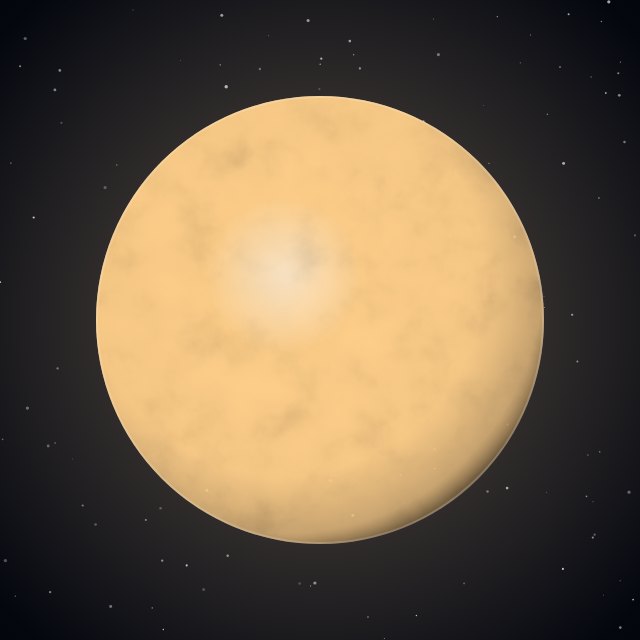
Stars· Distance 33.8 ly · size 8.8× Sun. The brighter of the Twins. The nearest giant star to the Sun, and the first first-magnitude star found to host a planet larger than Jupiter. On winter nights it shines beside Castor above and left of Orion, its orange tint — a surface of about 4,670 K — setting it apart from its white twin.
📍 Visible from where you are right now — computed in your browser
bearing · altitude · rise time · best time tonight
Where Pollux is in your sky right now: https://nowsky.org/solar/sky?sel=pollux — location and time set automatically, no login.
Distance and spectral type
Pollux is about 34 light-years away, a orange bright giant (spectral type K0IIIvar), in the constellation Gemini. Its apparent magnitude is 1.1, visible to the naked eye.
Stellar figures
| Distance | 33.8 ly |
|---|---|
| Magnitude | 1.14 — seventeenth brightest |
| Type | K0 orange giant |
| Surface temperature | ~4,670 K (Sun 5,772 K) |
| Planet | Pollux b (2.3 Jupiters, 590 days) |
Figures are representative approximations. Source: compiled from NASA and IAU public data.
Behind the name
The immortal twin, who begged Zeus to share his immortality with Castor. It hosts a planet.
Frequently asked
- How far is Pollux from Earth?
- 33.8 ly.
- How bright is Pollux (apparent magnitude)?
- 1.14 — seventeenth brightest.
- What kind of object is Pollux?
- K0 orange giant.
- What is the temperature of Pollux?
- ~4,670 K (Sun 5,772 K).
- Which constellation is Pollux in?
- Gemini.
- Where is Pollux in the sky right now?
- Open the sky view for your location and time and it shows the position in the sky right now.
The Sun from Pollux — a 5th-magnitude star in Sagittarius
Reverse the 33.8 light-years and look back from Pollux, and the Sun is a faint star of magnitude 4.9 — within naked-eye reach, but easily lost under a city sky — in the direction of Sagittarius, the point opposite Gemini. If Pollux b is real and had an observer, the Sun would be one point among the crowd of stars toward the galactic centre.
Pollux, by contrast, is a first-magnitude star in Earth's sky, because it is twice the Sun's mass and has swelled into a giant 43 times as luminous. Its diameter is nine times the Sun's and its surface, at 4,670 K, about a thousand degrees cooler, hence the orange tint. The Sun will pass through a similar stage in five billion years, so Pollux is close to a portrait of the Sun's future, visible in the winter sky.
The star in depth
Pollux is Beta Geminorum, yet it outshines Alpha, Castor, at magnitude 1.14 — the seventeenth-brightest star in the night sky. At 33.8 light-years it is the nearest giant star to the Sun, a K0 III of 1.9 solar masses, 8.8 solar radii and 43 solar luminosities. With a surface of 4,600 K it glows orange, settled in the stable helium-burning stage of a giant's life.
In Greek myth Pollux (Polydeuces) was the immortal twin, son of Zeus, while Castor was the mortal brother. In 2006 a planet of 2.3 Jupiter masses, Pollux b, was confirmed orbiting every 590 days — the first planet found around a first-magnitude star. The planet was later named Thestias in an International Astronomical Union public naming contest. Pollux also shows a weak magnetic field and X-ray emission.
From December to March look high in the east, above and left of Orion, where Pollux and Castor stand 4.5° apart; Pollux is slightly brighter and orange, Castor white. In the Sky view, set a February night and select Gemini to see the pair. The 3D neighbourhood view shows Pollux 33.8 light-years out, and the size ladder compares its 8.8-Sun diameter with our star.
Related
Figures are representative approximations. Simulated positions use J2000 mean elements.