Castor
What is Castor?
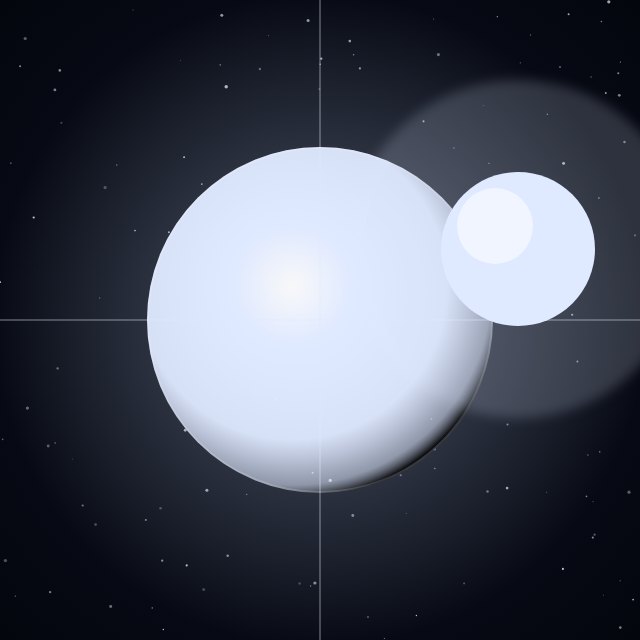
Stars· Distance 51 ly · sextuple system. One of the Gemini twins — a single point to the eye, but really six stars orbiting in three pairs. A small telescope splits it into two, making it a classic double; find it beside Pollux on winter nights.
📍 Visible from where you are right now — computed in your browser
bearing · altitude · rise time · best time tonight
Where Castor is in your sky right now: https://nowsky.org/solar/sky?sel=castor — location and time set automatically, no login.
Distance and spectral type
Castor is about 51 light-years away, a white main-sequence star (spectral type A2Vm), in the constellation Canis Minor. Its apparent magnitude is 1.6, visible to the naked eye.
Stellar figures
| Distance | 51 ly |
|---|---|
| Magnitude | 1.6 |
| System | six stars in three pairs |
| Constellation | Gemini |
Figures are representative approximations. Source: compiled from NASA and IAU public data.
Behind the name
The mortal twin of Greek myth. A telescope reveals a six-star system.
Frequently asked
- How far is Castor from Earth?
- 51 ly.
- How bright is Castor (apparent magnitude)?
- 1.6.
- Which constellation is Castor in?
- Canis Minor.
- Where is Castor in the sky right now?
- Open the sky view for your location and time and it shows the position in the sky right now.
The first stars proven to orbit each other, 1803
Castor's two bright stars, A and B, had been recorded as a double since 1718, but nobody knew whether they merely lay in the same direction or were truly bound. William Herschel measured their relative positions for 24 years from 1779, and in 1803 announced that they were circling each other — the first observational proof that Newton's gravity works beyond the solar system, and the moment the concept of a binary star was established.
The pair's orbital period is about 460 years, and their separation, now around 6 arcseconds, splits in a small telescope. They closed to under 2 arcseconds in the 1970s and are opening again, so this is a good era to observe them. They have not completed even one orbit since Herschel's first measurement — 220 years of records trace only about half the ellipse.
The star in depth
Castor is the second-brightest star of Gemini. It carries the Bayer letter alpha, yet it is slightly outshone by 'beta' Pollux. At 51 light-years and magnitude 1.6, it is the whiter, more northerly of the two stars standing side by side in the winter south-east.
Its true nature is a tangle of six stars. The two bright components a telescope shows, A and B, are each spectroscopic binaries, and a faint pair of red dwarfs, C, circles farther out — six suns bound by one gravity. First recorded as a double in 1718, it became historic in 1803 when William Herschel showed the pair actually orbit each other, the first proof that gravity works beyond the solar system.
Select Castor in the Sky view to highlight the twin figures of Gemini and follow the line from Castor down to Alhena at the twins' feet. In the real sky even a small telescope splits A from B, which is why Castor is a favourite first double star for beginners.
Related
Figures are representative approximations. Simulated positions use J2000 mean elements.