Procyon
What is Procyon?
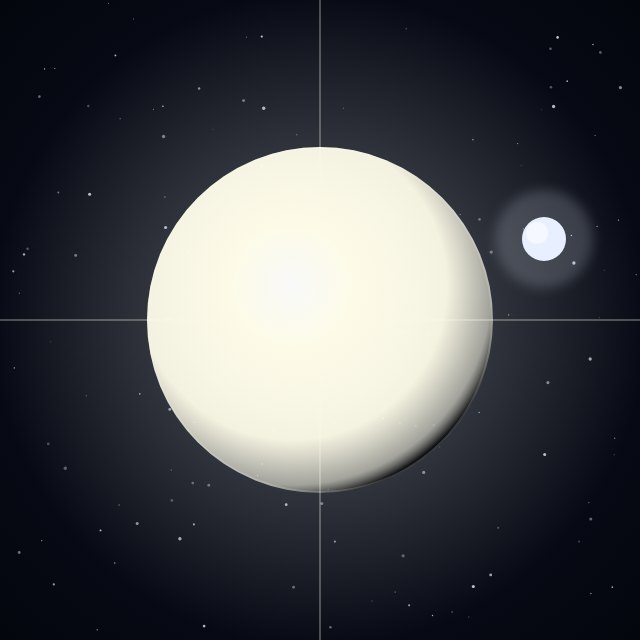
Stars· Distance 11.5 ly · size 2× Sun. The chief star of Canis Minor and a corner of the Winter Triangle. It looks bright because it is only 11.5 light-years away, and like Sirius it has a white-dwarf companion. Its name means "before the dog" — it rises ahead of Sirius.
📍 Visible from where you are right now — computed in your browser
bearing · altitude · rise time · best time tonight
Where Procyon is in your sky right now: https://nowsky.org/solar/sky?sel=procyon — location and time set automatically, no login.
Distance and spectral type
Procyon is about 12 light-years away, a yellow-white subgiant (spectral type F5IV-V), in the constellation Canis Major. Its apparent magnitude is 0.4, visible to the naked eye.
Stellar figures
| Distance | 11.46 ly |
|---|---|
| Magnitude | 0.34 — eighth brightest |
| Type | F5 subgiant + white dwarf B |
| Constellation | Canis Minor |
Figures are representative approximations. Source: compiled from NASA and IAU public data.
Behind the name
Greek "before the dog" — it rises shortly before Sirius. It too has a white-dwarf companion.
Frequently asked
- How far is Procyon from Earth?
- 11.46 ly.
- How bright is Procyon (apparent magnitude)?
- 0.34 — eighth brightest.
- What kind of object is Procyon?
- F5 subgiant + white dwarf B.
- Which constellation is Procyon in?
- Canis Major.
- Where is Procyon in the sky right now?
- Open the sky view for your location and time and it shows the position in the sky right now.
The Sun seen from Procyon — a 3rd-magnitude star in Aquila
Reverse the 11.5 light-years and look back from Procyon: the Sun appears as a star of magnitude 2.6, in the direction of Aquila near Altair — the point exactly opposite Procyon in our sky. About as bright as one of the stars of the Big Dipper, noticeable but unremarkable, and Earth invisible to any telescope.
Procyon itself is spectral type F5, slightly hotter than the Sun and seven times brighter. It is classed a subgiant because it has nearly exhausted the hydrogen at its core and begun swelling to twice the Sun's radius; within tens of millions of years it becomes a red giant. That the Sun is a 3rd-magnitude star in Procyon's sky is the nearest yardstick for how ordinary our star is in the galaxy.
The star in depth
Procyon is Alpha Canis Minoris, magnitude 0.34, the eighth-brightest star in the night sky. At 11.46 light-years it is among the twenty nearest stars, an F5 IV-V subgiant with 1.5 solar masses, twice the Sun's radius and seven times its luminosity. It has nearly used up the hydrogen in its core and has begun to swell; within a few million years it will grow into a red giant.
A wobble in its motion revealed an unseen companion in 1840, and in 1896 Lick Observatory spotted it: the white dwarf Procyon B, which packs 0.6 solar masses into a sphere 1.5 times the width of Earth. The two orbit every 40.8 years about 15 AU apart. That both Sirius and Procyon have white-dwarf partners is no coincidence — the heavier star in a pair ages first and becomes a white dwarf, a natural outcome of stellar evolution.
On winter evenings it forms the nearly equilateral Winter Triangle with Betelgeuse and Sirius in the southern sky. Lying north of Sirius it rises earlier, and from Korea it stands high on January and February nights. In the Sky view, set a winter night and look above and left of Sirius for the yellowish-white star. The 3D neighbourhood view shows its true distance relation to the Sun and Sirius, and the size ladder shows Procyon A's diameter.
Related
Figures are representative approximations. Simulated positions use J2000 mean elements.