Regulus
What is Regulus?
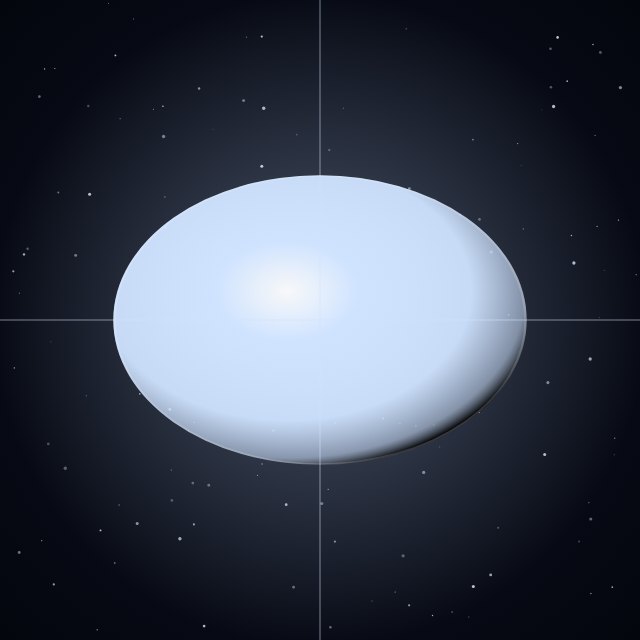
Stars· Distance 79 ly · size 3–4× Sun. The blue-white star at the heart of Leo, its name meaning 'little king'. Spinning once every 16 hours, it bulges so much at the equator that it is visibly flattened — find it at the base of the Sickle on spring evenings.
📍 Visible from where you are right now — computed in your browser
bearing · altitude · rise time · best time tonight
Where Regulus is in your sky right now: https://nowsky.org/solar/sky?sel=regulus — location and time set automatically, no login.
Distance and spectral type
Regulus is about 79 light-years away, a blue-white main-sequence star (spectral type B7V), in the constellation Taurus. Its apparent magnitude is 1.4, visible to the naked eye.
Stellar figures
| Distance | 79 ly |
|---|---|
| Magnitude | 1.4 — Leo's brightest |
| Rotation | one turn every ~16 h |
| Constellation | Leo |
Figures are representative approximations. Source: compiled from NASA and IAU public data.
Behind the name
Latin "little king". It lies on the ecliptic where the Moon and planets pass, and spins so fast it is flattened.
Frequently asked
- How far is Regulus from Earth?
- 79 ly.
- How bright is Regulus (apparent magnitude)?
- 1.4 — Leo's brightest.
- How long is a day on Regulus?
- one turn every ~16 h.
- Which constellation is Regulus in?
- Taurus.
- Where is Regulus in the sky right now?
- Open the sky view for your location and time and it shows the position in the sky right now.
Regulus's hidden partner, a white dwarf
Spectroscopy in 2008 confirmed that Regulus wobbles on a 40-day cycle. The unseen companion has about 0.3 solar masses and is interpreted as a white dwarf, the burnt-out core of a star. That companion explains Regulus's furious spin: swelling in its giant phase, it passed its outer layers to Regulus, and the material carried angular momentum that spun the star up to a 16-hour rotation.
Today's Regulus, then, is a star made heavier and faster by its neighbour's shed envelope. A binary that has finished such mass transfer has the structure of Algol, and Regulus shows the stage after that — transfer complete, only the white dwarf left. A pair of red dwarfs orbits farther out, making Regulus at least a quadruple system. Lying near the ecliptic it is often passed by the Moon and planets, but the intricate system behind it is visible only to a spectrograph.
The star in depth
Regulus is Leo's brightest star and a first-magnitude beacon lying almost exactly on the ecliptic. The Moon and planets pass close by regularly, and the Moon occasionally hides it altogether. At 79 light-years it is a near neighbour, and although it looks like a single star it is actually a system of four.
Its most remarkable trait is its spin. The equator races around at over 300 km/s, completing a turn every 16 hours or so, and the resulting centrifugal bulge makes the equatorial diameter more than 30% wider than the polar one — close to the speed at which the star would tear itself apart. Ancient Persian astronomers counted it among the four 'royal stars' that marked the seasons.
On spring evenings look for the backwards question mark of the Sickle in the southern sky; Regulus sits at its base. Select it in the Sky view to highlight the whole Lion, or open the 3D neighbours view to see its true position 79 light-years from the Sun.
Related
Figures are representative approximations. Simulated positions use J2000 mean elements.