Arcturus
What is Arcturus?
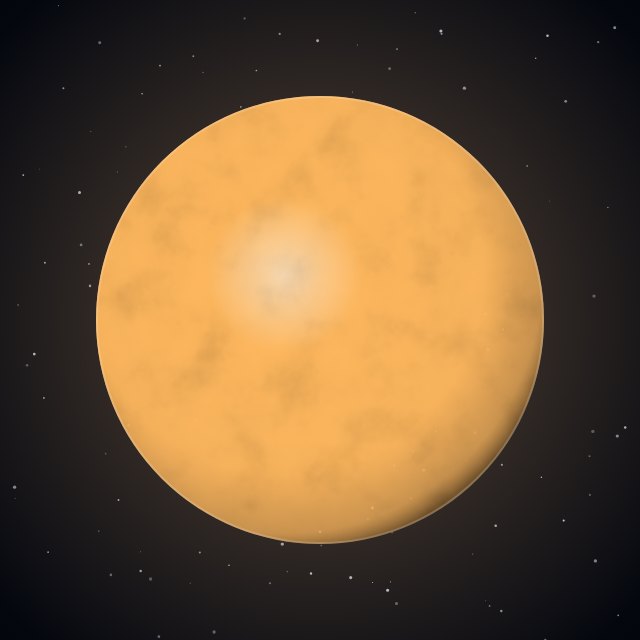
Stars· Distance 36.7 ly · size 25× Sun. The brightest star of the northern sky — an orange red giant that shows what the Sun will become. Follow the arc of the Big Dipper's handle on a spring night to find it. It races across the Galaxy on its own path and will fade from view in a few hundred thousand years.
📍 Visible from where you are right now — computed in your browser
bearing · altitude · rise time · best time tonight
Where Arcturus is in your sky right now: https://nowsky.org/solar/sky?sel=arcturus — location and time set automatically, no login.
Distance and spectral type
Arcturus is about 37 light-years away, a orange bright giant (spectral type K2IIIp), in the constellation Cancer. Its apparent magnitude is 0, visible to the naked eye.
Stellar figures
| Distance | 36.7 ly |
|---|---|
| Magnitude | −0.05 — brightest in the northern sky |
| Type | K1.5 red giant |
| Constellation | Boötes |
Figures are representative approximations. Source: compiled from NASA and IAU public data.
Behind the name
Greek "guardian of the bear". Its light, focused on photocells, switched on the 1933 Chicago World's Fair.
Frequently asked
- How far is Arcturus from Earth?
- 36.7 ly.
- How bright is Arcturus (apparent magnitude)?
- −0.05 — brightest in the northern sky.
- What kind of object is Arcturus?
- K1.5 red giant.
- Which constellation is Arcturus in?
- Cancer.
- Where is Arcturus in the sky right now?
- Open the sky view for your location and time and it shows the position in the sky right now.
The world's fair lit by starlight, 1933
The opening-night lights of the Chicago World's Fair on 27 May 1933 were switched on by the light of Arcturus. Four observatories focused the star's light onto photocells, and the amplified current threw the switches at the fairground. The distance was then reckoned at about 40 light-years, so the staging was that light which left the star during Chicago's previous fair, in 1893, had arrived forty years later to open the next.
At the modern value of 36.7 light-years the light had left in 1896, but the symbolism stands. Arcturus is passing through the solar neighbourhood at 122 km/s, so its proper motion is large and in half a million years it will be too far to see with the naked eye. It is thought to have come from the galactic halo rather than the disk, and the "Arcturus stream" of stars moving with it may be the remains of a small galaxy swallowed by the Milky Way.
The star in depth
Arcturus, Alpha Boötis, is the brightest star in the northern celestial hemisphere at magnitude −0.05. It lies 36.7 light-years away and is a K1.5 III red giant: about the Sun's mass, but having exhausted the hydrogen in its core it has swollen to 25 solar radii and shines 110 times as bright in visible light, 170 times overall. Its surface is a relatively cool 4,300 K, which gives it its orange tint.
The name means guardian of the bear, from its position trailing Ursa Major. On spring nights, extending the arc of the Big Dipper's handle leads to Arcturus and on to Spica — the Spring Arc. Unlike most nearby stars, Arcturus follows a steeply inclined orbit and sweeps past us at 122 km/s, so it is thought to belong to the Galaxy's halo population. In 1933 the Chicago World's Fair was lit by a signal from Arcturus's light, which had left the star forty years earlier.
Look high in the east on April to June evenings; by summer it slides into the western sky after dusk. In the Sky view, set a May night and follow the Dipper's handle down to the obvious orange star. The 3D neighbourhood view shows its place 36.7 light-years out, and the size ladder puts its 25-Sun diameter beside our own star — a preview of the Sun about five billion years from now.
Related
Figures are representative approximations. Simulated positions use J2000 mean elements.