Spica
What is Spica?
Stars· Distance 250 ly · size 7.5× Sun (primary). The ear of wheat in the Virgin's hand. Continue the Big Dipper's arc past Arcturus on a spring night to reach this blue-white star — two hot stars orbiting each other every four days. Hipparchus used it to discover precession in the second century BC.
📍 Visible from where you are right now — computed in your browser
bearing · altitude · rise time · best time tonight
Where Spica is in your sky right now: https://nowsky.org/solar/sky?sel=spica — location and time set automatically, no login.
Distance and spectral type
Spica is about 250 light-years away, a blue-white main-sequence star (spectral type B1V), in the constellation Leo. Its apparent magnitude is 1, visible to the naked eye.
Stellar figures
| Distance | 250 ly |
|---|---|
| Magnitude | 0.97 — sixteenth brightest |
| Type | B1 + B2 close binary, 4-day period |
| Constellation | Virgo |
Figures are representative approximations. Source: compiled from NASA and IAU public data.
Behind the name
Latin "ear of grain" in the maiden's hand. Hipparchus discovered precession using this star.
Frequently asked
- How far is Spica from Earth?
- 250 ly.
- How bright is Spica (apparent magnitude)?
- 0.97 — sixteenth brightest.
- What kind of object is Spica?
- B1 + B2 close binary, 4-day period.
- Which constellation is Spica in?
- Leo.
- Where is Spica in the sky right now?
- Open the sky view for your location and time and it shows the position in the sky right now.
Two stars pulled out of shape every four days
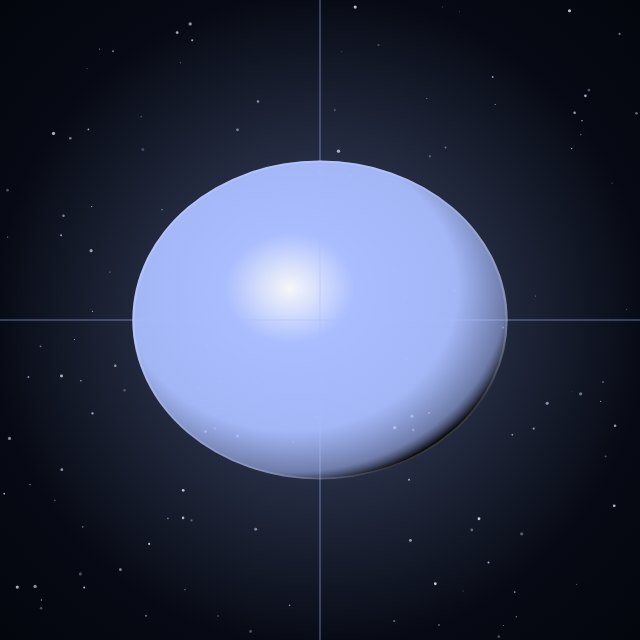
Spica's two stars circle each other every 4.01 days at 0.12 AU — a third of Mercury's orbit. That close, each star's gravity pulls the other into a rugby-ball shape, and so Spica varies by about 3 percent on a four-day cycle even though the stars never eclipse: the broad and narrow faces of the elongated stars turn toward us in turn. Such stars are called ellipsoidal variables, and Spica is the archetype.
The primary has eleven solar masses and the companion seven, both candidates to become supernovae one day. The primary also shows Beta Cephei pulsations, its surface trembling on a cycle of hours, and one reading is that the tides between the two stars drive those pulsations. At 250 light-years the system is a laboratory for the physics of close binaries, tested on one of the brightest stars in the sky.
The star in depth
Spica, Alpha Virginis, shines at magnitude 0.97 as the sixteenth-brightest star in the night sky, 250 light-years away. It looks single, but it is a close binary of two hot stars — a B1 III-IV primary of eleven solar masses and a B2 V companion of seven — only 0.12 AU apart and circling each other every 4.01 days. Tidal forces stretch both into egg shapes, so the system's brightness varies slightly with orbital phase, making it an ellipsoidal variable.
The name is Latin for ear of grain, the wheat held by the harvest goddess who is Virgo. Around 129 BC Hipparchus compared Spica's position with records 150 years older and discovered precession, the slow wobble of Earth's axis. Lying near the ecliptic, it is regularly passed by the Moon and planets and periodically hidden by the Moon. The stars are only about twelve million years old, and the primary will eventually explode as a supernova.
From April to June it rises in the south-east and stands in the southern evening sky, the end point of the Spring Arc that runs from the Big Dipper's handle through Arcturus. With no bright neighbours it is easy to spot as a lone blue-white star. In the Sky view, set a May night and select Virgo. The 3D neighbourhood view and the size ladder show Spica A's distance and diameter.
Related
Figures are representative approximations. Simulated positions use J2000 mean elements.