Capella
What is Capella?
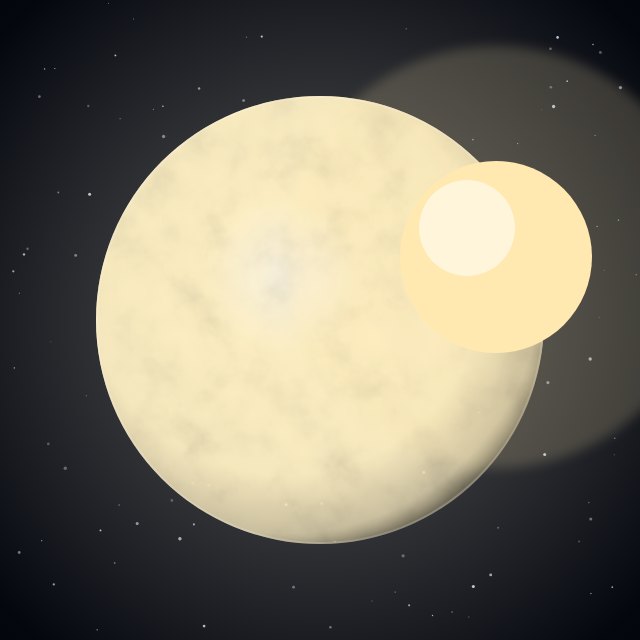
Stars· Distance 42.9 ly · sizes 12× and 9× Sun. The yellow star high in the northern winter sky. To the eye it is one star, but it is a pair of yellow giants far brighter than the Sun, circling each other every 104 days. From Korea it is visible almost all year and marks a corner of the Winter Hexagon.
📍 Visible from where you are right now — computed in your browser
bearing · altitude · rise time · best time tonight
Where Capella is in your sky right now: https://nowsky.org/solar/sky?sel=capella — location and time set automatically, no login.
Distance and spectral type
Capella is about 43 light-years away, a red star (spectral type M1:), in the constellation Perseus. Its apparent magnitude is 0.1, visible to the naked eye.
Stellar figures
| Distance | 42.9 ly |
|---|---|
| Magnitude | 0.08 — sixth brightest |
| Members | two yellow giants, 104-day period |
| Constellation | Auriga |
Figures are representative approximations. Source: compiled from NASA and IAU public data.
Behind the name
Latin "little she-goat" — Amalthea who nursed Zeus. Actually two yellow giants orbiting every 104 days.
Frequently asked
- How far is Capella from Earth?
- 42.9 ly.
- How bright is Capella (apparent magnitude)?
- 0.08 — sixth brightest.
- Which constellation is Capella in?
- Perseus.
- Where is Capella in the sky right now?
- Open the sky view for your location and time and it shows the position in the sky right now.
The first giants split apart — interferometry in 1919
Capella's two giants are 0.05 arcseconds apart — a 36,000th of the Moon's width — and no telescope shows them as two points. In 1899 a spectrograph caught their spectral lines splitting and merging on a 104-day cycle, revealing a binary, and in 1919 Anderson at Mount Wilson "resolved" the pair for the first time with an interferometer of two mirrors mounted on the 2.5 m telescope — the first spectroscopic binary ever resolved that way.
The two stars, at 2.5 and 2.6 solar masses, are nearly twins but at different stages: the slightly heavier one is in the stable phase of burning helium at its core, while the lighter one has not yet ignited helium and, in transition, spins faster and is more active. That a 4 percent difference in mass puts them in such different phases is a physical demonstration of how sensitive stellar evolution is to mass.
The star in depth
Capella, Alpha Aurigae, shines at magnitude 0.08 as the sixth-brightest star in the night sky. It lies 42.9 light-years away and looks like a single star, but it is a close binary: two yellow giants of about 2.5 solar masses each (Aa and Ab) orbiting 0.7 AU apart every 104 days. Their radii are 12 and 9 times the Sun's and their luminosities 79 and 73 Suns, with surface temperatures similar to the Sun's — hence the yellow colour.
The name is Latin for little she-goat. Auriga is pictured as the charioteer Erichthonius carrying the goat Amalthea on his shoulder, and the small triangle of stars next to Capella are the Kids. Both giants have finished their core hydrogen and are burning helium, and a distant pair of red dwarfs, H and L, make the system a quadruple. Capella was among the first stars shown to be a binary by the periodic shift of its spectral lines, in 1899.
At declination +46° it is almost circumpolar from Seoul, dipping only briefly below the northern horizon. It rises in the north-east on December evenings and passes near the zenith around midnight in midwinter, forming the Winter Hexagon with Orion and Taurus. In the Sky view, set a January night and look almost straight up for the yellow star.
Related
Figures are representative approximations. Simulated positions use J2000 mean elements.