Aldebaran
What is Aldebaran?
Stars· Distance 65 ly · size 44× Sun. The red eye of the Bull. Extend Orion's Belt up and to the right on a winter night to reach this orange red giant, which appears to sit in the Hyades cluster but is really only half as far. Pioneer 10 will drift past it in two million years.
📍 Visible from where you are right now — computed in your browser
bearing · altitude · rise time · best time tonight
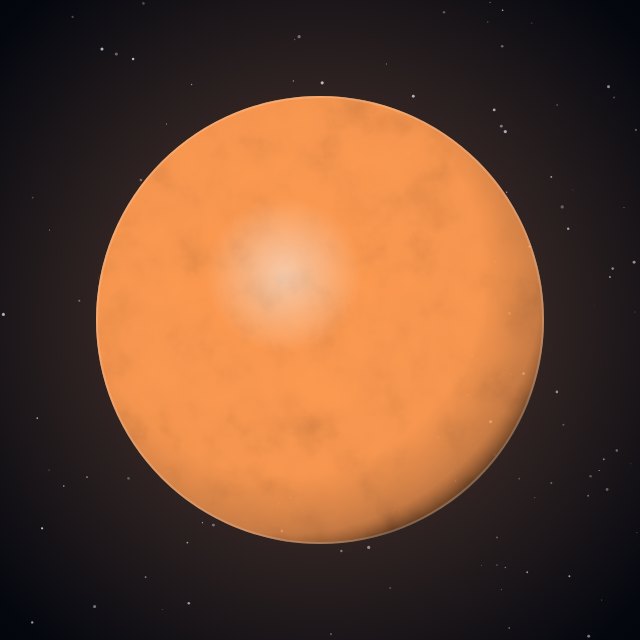
Where Aldebaran is in your sky right now: https://nowsky.org/solar/sky?sel=aldebaran — location and time set automatically, no login.
Distance and spectral type
Aldebaran is about 67 light-years away, a orange bright giant (spectral type K5III), in the constellation Gemini. Its apparent magnitude is 0.9, visible to the naked eye.
Stellar figures
| Distance | 65 ly |
|---|---|
| Magnitude | 0.86 — fourteenth brightest |
| Type | K5 red giant |
| Constellation | Taurus |
Figures are representative approximations. Source: compiled from NASA and IAU public data.
Behind the name
Arabic "the follower" — it trails the Pleiades across the sky. Pioneer 10 is drifting toward it.
Frequently asked
- How far is Aldebaran from Earth?
- 65 ly.
- How bright is Aldebaran (apparent magnitude)?
- 0.86 — fourteenth brightest.
- What kind of object is Aldebaran?
- K5 red giant.
- Which constellation is Aldebaran in?
- Gemini.
- Where is Aldebaran in the sky right now?
- Open the sky view for your location and time and it shows the position in the sky right now.
The planet of Aldebaran — found, lost, found again
A planet around Aldebaran was first suspected in 1993, and in 2015 radial-velocity data announced Aldebaran b, six Jupiter masses in a 629-day orbit. But a 2019 reanalysis concluded that the signal could not be distinguished from the star's own surface oscillations — a red giant's surface heaves slowly and produces false signals that mimic a planet.
The debate is a specimen of why planet hunting around old stars is hard: the star swells and swallows its inner planets, and the signals of any survivors are buried in the star's pulsations. Studies with more data since the 2020s have again supported the planet, and Aldebaran b remains a candidate. If confirmed, it would make Aldebaran one of the few naked-eye stars, at 65 light-years, known to have a planet.
The star in depth
Aldebaran, Alpha Tauri, shines at magnitude 0.86 as the fourteenth-brightest star in the night sky. It lies 65 light-years away and is a K5 III red giant: about 1.2 solar masses, but having exhausted its core hydrogen it has swollen to 44 solar radii and 440 solar luminosities. Its surface is around 3,900 K, giving the orange colour, and the name is Arabic for the follower, because it rises after the Pleiades.
It sits in the middle of the V-shaped Hyades cluster and looks like a member, but the Hyades lie 153 light-years away — Aldebaran is a foreground star at half that distance, superimposed by chance. Lying close to the ecliptic, it is occasionally hidden by the Moon and, rarely, passed by planets. A planet of about six Jupiter masses, Aldebaran b, has been reported. Pioneer 10, launched in 1972, is now heading in this star's direction.
From December to February, extend the three Belt stars of Orion up and to the right in the southern evening sky to reach Aldebaran, and further on to the Pleiades. In the Sky view, set a January night and select Taurus to see the red star at the tip of the V. Compare its 65-light-year distance in the 3D neighbourhood view and its 44-Sun diameter on the size ladder.
Related
Figures are representative approximations. Simulated positions use J2000 mean elements.