Antares
What is Antares?
Stars· Distance 550 ly · size ~680× Sun. The red supergiant burning at the Scorpion's heart. Put it in the Sun's place and it would swallow Mars's orbit and reach the asteroid belt; its name means rival of Mars. Look low in the south on summer nights, where it often sits near the red planet.
📍 Visible from where you are right now — computed in your browser
bearing · altitude · rise time · best time tonight
Where Antares is in your sky right now: https://nowsky.org/solar/sky?sel=antares — location and time set automatically, no login.
Distance and spectral type
Antares is about 554 light-years away, a red supergiant (spectral type M1Ib), in the constellation Libra. Its apparent magnitude is 1.1, visible to the naked eye.
Stellar figures
| Distance | ~550 ly |
|---|---|
| Magnitude | 1.0 (varies 0.6–1.6) — fifteenth brightest |
| Type | M1.5 red supergiant |
| Constellation | Scorpius |
Figures are representative approximations. Source: compiled from NASA and IAU public data.
Behind the name
Greek "rival of Ares (Mars)" for its red color. In the Sun's place it would engulf Mars's orbit.
Frequently asked
- How far is Antares from Earth?
- ~550 ly.
- How bright is Antares (apparent magnitude)?
- 1.0 (varies 0.6–1.6) — fifteenth brightest.
- What kind of object is Antares?
- M1.5 red supergiant.
- Which constellation is Antares in?
- Libra.
- Where is Antares in the sky right now?
- Open the sky view for your location and time and it shows the position in the sky right now.
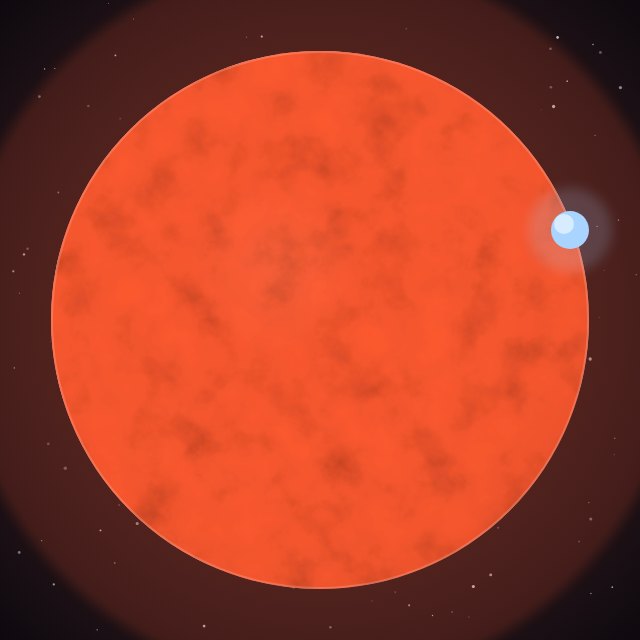
The green star beside the red one — Antares B
Two and a half arcseconds from Antares sits a 5th-magnitude companion, Antares B. Its true colour is blue-white (spectral type B2.5), yet beside the red primary it looks green and has long been called the "green star" — an illusion in which the eye reads white next to red as its complement. It was first found in 1819 during a lunar occultation of Antares, and it still famously stands alone for a few seconds when the Moon hides the primary.
The two are physically bound, circling each other over thousands of years at about 550 AU. B is a bright star in its own right, seven solar masses and 2,500 times the Sun's luminosity, but the primary outshines it more than ten thousand times. Splitting the pair in a small telescope takes a night of steady seeing and high magnification, and the moment the green point pops out of Antares's red glare is a classic of double-star observing.
The star in depth
Antares, Alpha Scorpii, averages magnitude 1.0 and ranks fifteenth among the night sky's stars. About 550 light-years away, it is an M1.5 Iab red supergiant of 12 to 15 solar masses and roughly 680 solar radii — in the Sun's place it would extend past the orbit of Mars at 1.5 AU into the inner asteroid belt. Its surface is a cool 3,500 K, but its sheer size gives it about 75,000 times the Sun's luminosity.
The name is Greek for rival of Ares, the war god whose planet is Mars: lying near the ecliptic, Antares is often passed by the red planet and the two seem to compete in colour. Its outer layers pulsate irregularly, so its brightness wanders between magnitudes 0.6 and 1.6, and 2.7 arcseconds away sits a magnitude 5.5 blue-white companion, Antares B, which looks greenish by contrast. Only about twelve million years old, it is a candidate to go supernova within the next million years; in 2017 interferometry imaged convection cells on its surface directly.
From June to August, look low in the southern evening sky for the red star at the centre of the Scorpion's S-shaped curve; from Korea it climbs only about 30° high, so an open southern horizon helps. In the Sky view, set a July night and select Scorpius. On the size ladder, place Antares A beside the Sun and Earth's orbit to see how vast a supergiant is, and check its 550-light-year distance in the 3D neighbourhood view.
Related
Figures are representative approximations. Simulated positions use J2000 mean elements.