Mira
What is Mira?
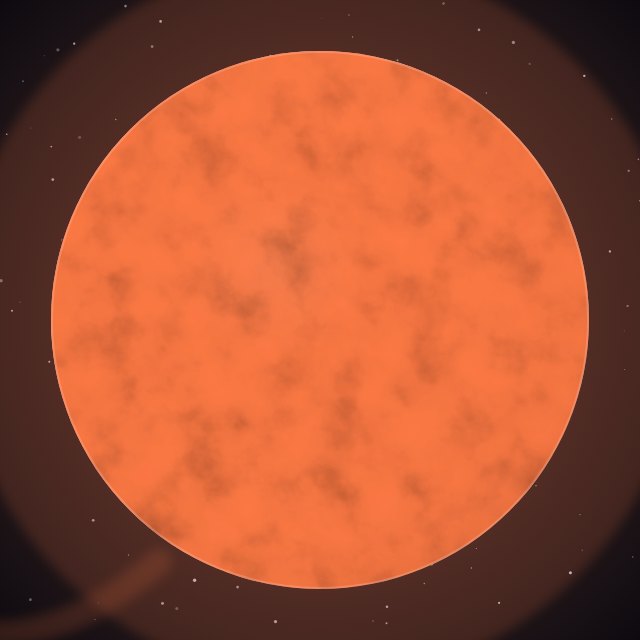
Stars· Distance ~300 ly · size 300–400× Sun. The 'Wonderful Star' of Cetus — a red giant that swells and shrinks over about 11 months, swinging from an easy naked-eye second magnitude down to telescope-only tenth. Hundreds of times the Sun's size, it trails a 13-light-year tail behind it as it speeds through space.
📍 Visible from where you are right now — computed in your browser
bearing · altitude · rise time · best time tonight
Where Mira is in your sky right now: https://nowsky.org/solar/sky?sel=mira — location and time set automatically, no login.
Distance and spectral type
Mira is about 299 light-years away, a red bright giant (spectral type M7IIIe), in the constellation Cetus. Its apparent magnitude is 3, visible to the naked eye.
Stellar figures
| Distance | ~300 ly |
|---|---|
| Magnitude | swings between 2 and 10 |
| Period | ~332 d |
| Constellation | Cetus |
Figures are representative approximations. Source: compiled from NASA and IAU public data.
Behind the name
Latin "the wonderful". The first periodic variable (1596); it trails a 13-ly tail through space.
Frequently asked
- How far is Mira from Earth?
- ~300 ly.
- How bright is Mira (apparent magnitude)?
- swings between 2 and 10.
- How long is the orbital period of Mira?
- ~332 d.
- Which constellation is Mira in?
- Cetus.
- Where is Mira in the sky right now?
- Open the sky view for your location and time and it shows the position in the sky right now.
Mira B, the white dwarf feeding on a giant's envelope
Mira has a partner. Mira B, about 70 AU away, is a white dwarf that captures part of the wind Mira sheds, forms an accretion disk and emits X-rays. Hubble first resolved the two in 1997, and a 2007 Chandra X-ray image showed a bridge of material joining them — the outer layers of the bloated giant flowing to its small companion.
The arrangement is the archetype of the class called symbiotic stars. When the material Mira B accumulates reaches a threshold, fusion can ignite on its surface as a nova, and in the far future, when Mira sheds its envelope entirely into a planetary nebula, the companion is expected to twist that nebula out of symmetry. The 13-light-year tail Mira leaves behind in space also exists because the pair plough through the interstellar medium at 130 km/s.
The star in depth
Mira is a red giant in Cetus. David Fabricius noticed its changing brightness in 1596, and it later earned the Latin name 'the Wonderful'. Over a cycle of about 332 days it pulsates in and out, its brightness changing several hundredfold — as bright as Polaris at peak, apparently gone at minimum. The whole class of such stars is named after it: Mira variables.
It is a preview of what a Sun-like star becomes near the end of its life. Bloated to 300–400 times the Sun's diameter, it is shedding its outer layers and will slowly build a planetary nebula. In 2007 the ultraviolet satellite GALEX found that Mira, racing along at 130 km/s, drags a comet-like tail 13 light-years long behind it. A white-dwarf companion feeds on the material it sheds.
Look for it near the neck of Cetus on autumn evenings, though whether your eyes catch it depends on where it is in its cycle. Select Mira in the Sky view to learn its position, and set it on the size ladder beside the Sun and Betelgeuse to see at a glance how far it has swollen.
Related
Figures are representative approximations. Simulated positions use J2000 mean elements.