Proxima Centauri
What is Proxima Centauri?
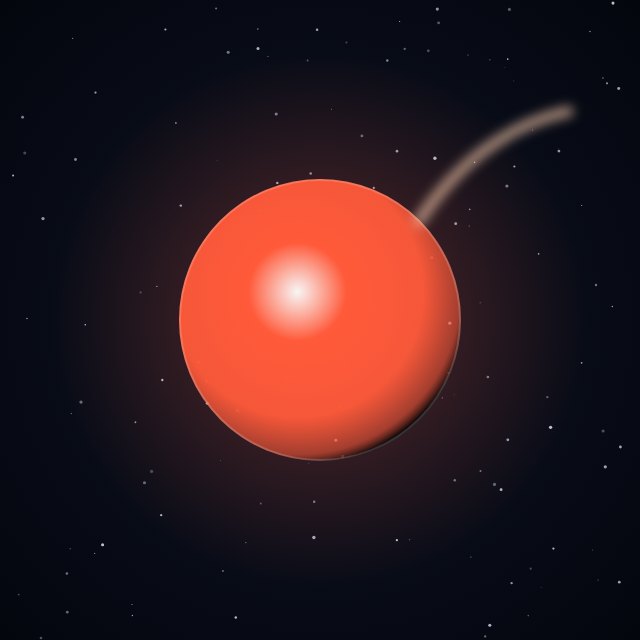
Stars· Distance 4.25 ly · size 0.15× Sun. Our nearest stellar neighbor — a faint red dwarf invisible to the naked eye, hosting the temperate planet Proxima b. See its true 3D position in Nearby stars view.
📍 Visible from where you are right now — computed in your browser
bearing · altitude · rise time · best time tonight
Stellar figures
| Distance | 4.25 ly — nearest star |
|---|---|
| Type | red dwarf |
| Planets | Proxima b (habitable zone) |
Figures are representative approximations. Source: compiled from NASA and IAU public data.
Frequently asked
- How far is Proxima Centauri from Earth?
- 4.25 ly — nearest star.
- What kind of object is Proxima Centauri?
- red dwarf.
- In one line, what is Proxima Centauri?
- Stars — Our nearest stellar neighbor — a faint red dwarf invisible to the naked eye, hosting the temperate planet Proxima b.
Proxima's three planets — b, c and d
Proxima b (2016) was the beginning. In 2019 radial-velocity data suggested a candidate, Proxima c, far out at 1.5 AU with a five-year period — estimated around seven Earth masses but still unconfirmed — and in 2022 Proxima d was confirmed, hugging the star with a five-day orbit. At a quarter of Earth's mass, d is among the lightest planets ever detected by radial velocity.
The three planets show that the nearest star to the Sun has a planetary system, but habitability is another matter. Proxima is a red dwarf whose frequent superflares could strip a planet's atmosphere, and b is tidally locked with one side in permanent day. Extremely large ground telescopes plan to take spectra of b's atmosphere directly in the late 2020s, and those results will be the first test of whether the nearest Earth-sized planet is a place one could live.
The star in depth
Proxima Centauri is the Sun's nearest neighbor — 4.25 light-years, still a 70,000-year trip at Voyager 1's speed. An eighth of a solar mass, this red dwarf is invisible to the naked eye and went unnoticed until 1915.
It has planets. Proxima b, at a minimum 1.1 Earth masses, orbits in the habitable zone — our closest potentially Earth-like world. The catch: Proxima is a violent flare star, so whether the planet kept an atmosphere is the open question.
Red dwarfs live for trillions of years — hundreds of times the universe's current age. See the true 3D layout of the Alpha Centauri triple (A, B, Proxima) in the Nearby Stars view.
Proxima is secretly a champion of longevity — small stars sip their fuel, and this one will still be burning trillions of years after the Sun is gone. The catch for habitability is its violent superflares, which may have stripped planet Proxima b's atmosphere. Breakthrough Starshot dreams of sending light-sail nanoprobes there at 20% of light speed — a twenty-year trip.
Related
Figures are representative approximations. Simulated positions use J2000 mean elements.