Fomalhaut
What is Fomalhaut?
Stars· Distance 25.1 ly · size 1.8× Sun. The Southern Fish's mouth, shining alone in the southern autumn sky — the lonely first-magnitude star of a season poor in bright stars. A sharp dust ring around it earned the nickname "Eye of Sauron". A young white star 25 light-years away.
📍 Visible from where you are right now — computed in your browser
bearing · altitude · rise time · best time tonight
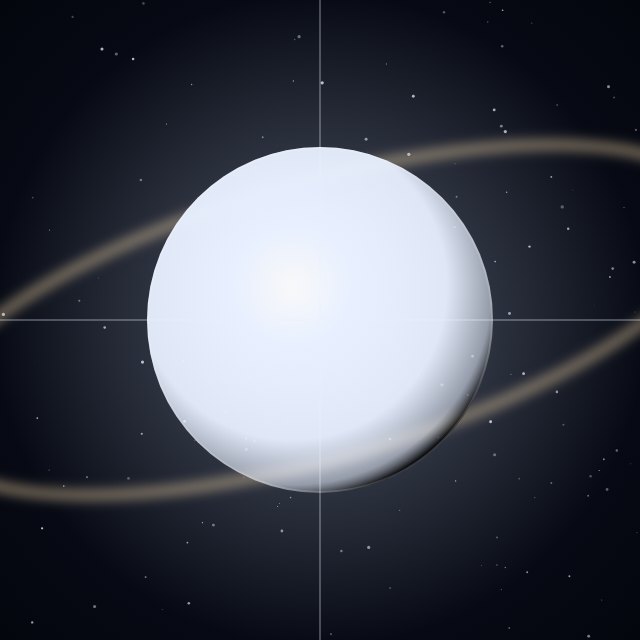
Where Fomalhaut is in your sky right now: https://nowsky.org/solar/sky?sel=fomalhaut — location and time set automatically, no login.
Distance and spectral type
Fomalhaut is about 25 light-years away, a white main-sequence star (spectral type A3V), in the constellation Corvus. Its apparent magnitude is 1.2, visible to the naked eye.
Stellar figures
| Distance | 25.1 ly |
|---|---|
| Magnitude | 1.16 — eighteenth brightest |
| Type | A3 white main-sequence |
| Note | dust ring of 140 AU radius |
Figures are representative approximations. Source: compiled from NASA and IAU public data.
Behind the name
Arabic "mouth of the fish" — the Lonely Star of autumn, where Hubble imaged a planet candidate in 2008.
Frequently asked
- How far is Fomalhaut from Earth?
- 25.1 ly.
- How bright is Fomalhaut (apparent magnitude)?
- 1.16 — eighteenth brightest.
- What kind of object is Fomalhaut?
- A3 white main-sequence.
- What is notable about Fomalhaut?
- dust ring of 140 AU radius.
- Which constellation is Fomalhaut in?
- Corvus.
- Where is Fomalhaut in the sky right now?
- Open the sky view for your location and time and it shows the position in the sky right now.
Three nested belts seen by Webb
Hubble's image of Fomalhaut showed one ring. When Webb looked again in infrared in 2023 there were three: a warm dust belt inside 20 AU of the star, an intermediate belt, and the large outer ring. A structure corresponding to our asteroid belt and Kuiper belt appeared around another star all at once, and the gaps between the belts are read as lanes swept clear by unseen planets.
The "planet" Fomalhaut b, found inside the ring in the Hubble era, was reclassified in 2020 as a cloud of dust from a collision between two bodies — it spread and faded in successive images. Webb's picture shows a similar dusty clump in the ring, suggesting such great collisions are not rare here. This young star, 440 million years old, is a live view from 25 light-years of the final stage of a planetary system's assembly.
The star in depth
Fomalhaut, Alpha Piscis Austrini, shines at magnitude 1.16 as the eighteenth-brightest star in the night sky. It lies 25.1 light-years away and is an A3 V white main-sequence star of 1.9 solar masses, 1.8 solar radii and 17 solar luminosities, only about 400 million years old. The name is Arabic for the fish's mouth: the Southern Fish drinks the water poured out by Aquarius.
What made it famous is its dust ring. Hubble's image of a crisp ring about 140 AU in radius earned the nickname Eye of Sauron, and in 2008 an object inside the ring, Fomalhaut b, was announced as the first exoplanet candidate photographed directly in visible light. Later observations watched it spread out and fade, and it is now thought to have been a dust cloud from a collision of two planetesimals. In 2023 the James Webb Space Telescope found two additional inner belts, analogues of our asteroid and Kuiper belts.
From September to November it sits low in the southern evening sky. With no bright stars nearby it is called the lonely star of autumn, and from Korea it climbs only about 20° high. In the Sky view, set an October night and look just above the southern horizon for the solitary bright star. Check its 25-light-year distance and 1.8-Sun diameter in the 3D neighbourhood view and on the size ladder.
Related
Figures are representative approximations. Simulated positions use J2000 mean elements.