Achernar
What is Achernar?
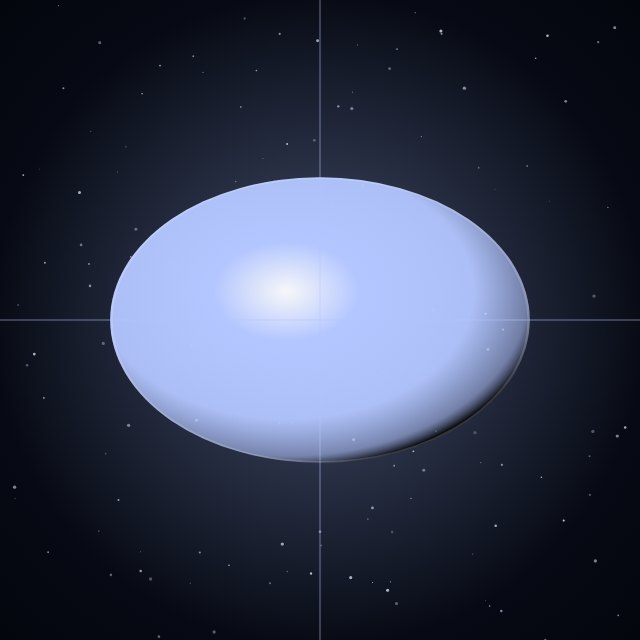
Stars· Distance 139 ly · size 7–10× Sun (oblate). The blue star at the end of the celestial river Eridanus. It spins so fast that its equator bulges 40% wider than its poles — the flattest star known. Too far south to see from Korea, it is a landmark of southern spring and summer skies.
📍 Visible from where you are right now — computed in your browser
bearing · altitude · rise time · best time tonight
Where Achernar is in your sky right now: https://nowsky.org/solar/sky?sel=achernar — location and time set automatically, no login.
Distance and spectral type
Achernar is about 139 light-years away, a blue-white main-sequence star (spectral type B3Vp), in the constellation Eridanus. Its apparent magnitude is 0.5, visible to the naked eye.
Stellar figures
| Distance | 139 ly |
|---|---|
| Magnitude | 0.46 — ninth brightest |
| Type | B6 blue main-sequence |
| Note | flattest known star, equator 1.4× poles |
Figures are representative approximations. Source: compiled from NASA and IAU public data.
Behind the name
Arabic "end of the river". The flattest star known — it spins so fast its equator bulges 56%.
Frequently asked
- How far is Achernar from Earth?
- 139 ly.
- How bright is Achernar (apparent magnitude)?
- 0.46 — ninth brightest.
- What kind of object is Achernar?
- B6 blue main-sequence.
- What is notable about Achernar?
- flattest known star, equator 1.4× poles.
- Which constellation is Achernar in?
- Eridanus.
- Where is Achernar in the sky right now?
- Open the sky view for your location and time and it shows the position in the sky right now.
The temperature gap on a flattened star
A star spinning as fast as Achernar has an uneven surface temperature. The equator, thrown outward by centrifugal force, lies farther from the centre where gravity is weaker, and gives off less light and heat; the poles, closer to the centre, run hot. Through this "gravity darkening" Achernar's poles are computed at nearly 20,000 °C and its equator around 10,000 — a factor of two across one star's surface.
As a result its brightness and colour depend on the viewing angle — brighter and bluer from the poles, dimmer and redder from the equator. Earth sees Achernar almost equator-on, so our measurements describe its "dark side". To find such a star's true luminosity its shape and inclination must be measured first, and Achernar is the star to which that method was first applied with precision.
The star in depth
Achernar, Alpha Eridani, shines at magnitude 0.46 as the ninth-brightest star in the night sky. It lies 139 light-years away and is a B6 Vep blue main-sequence star of about six solar masses, with a surface near 15,000 K and a luminosity above 3,000 Suns. The name is Arabic for the river's end: it marks where the celestial river Eridanus flows away to the south.
What makes it extraordinary is its shape. Spinning at more than 250 km/s at the equator, it is flung outward by centrifugal force into an oblate spheroid whose equatorial diameter is 1.4 times its polar diameter — measured directly with interferometers. As a result its poles are far hotter and brighter than its equator. The rapid rotation sheds a disc of gas around the star, which gives its spectral class the e for emission lines, and a small companion circles it every seven years.
At declination −57° it never rises from Korea. In the southern hemisphere it stands high on October to December evenings, a reference point in the star-poor southern autumn sky together with Fomalhaut and Canopus, and it lies close to the Small Magellanic Cloud. In the Sky view, switch the location to Sydney and set a November night to find Achernar near the zenith.
Related
Figures are representative approximations. Simulated positions use J2000 mean elements.