Alpha Centauri
What is Alpha Centauri?
Stars· Distance 4.37 ly · size 1.2× Sun (A). The nearest star system to the Sun: Sun-like A and slightly smaller B circle each other every 80 years, with the red dwarf Proxima far outside. It is the third-brightest point in the southern sky and never rises from Korea. See its distance in the 3D neighbourhood view.
📍 Visible from where you are right now — computed in your browser
bearing · altitude · rise time · best time tonight
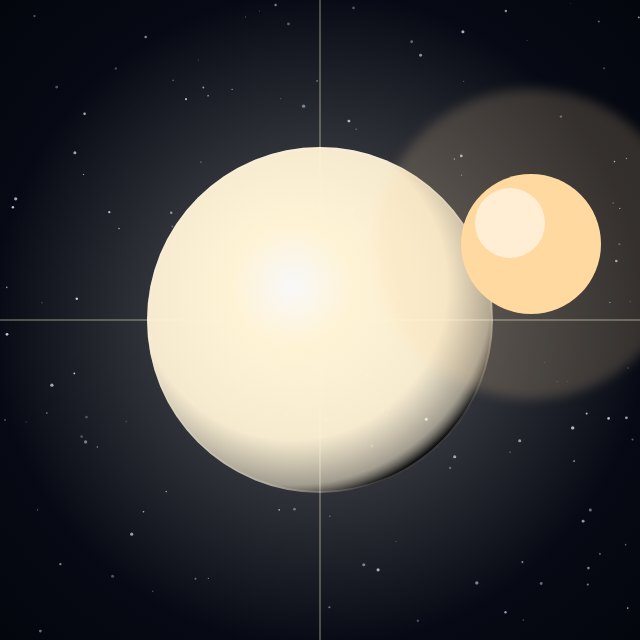
Where Alpha Centauri is in your sky right now: https://nowsky.org/solar/sky?sel=alpha centauri — location and time set automatically, no login.
Distance and spectral type
Alpha Centauri is about 4 light-years away, a yellow main-sequence star (spectral type G2V), in the constellation Crux. Its apparent magnitude is -0.3, visible to the naked eye.
Stellar figures
| Distance | 4.37 ly — nearest star system |
|---|---|
| Magnitude | −0.27 combined, third brightest |
| Members | A (G2V), B (K1V), Proxima |
| Period | 79.9 yr |
Figures are representative approximations. Source: compiled from NASA and IAU public data.
Behind the name
The nearest star system (4.3 ly). Breakthrough Starshot aims to send tiny probes here.
Frequently asked
- How far is Alpha Centauri from Earth?
- 4.37 ly — nearest star system.
- How bright is Alpha Centauri (apparent magnitude)?
- −0.27 combined, third brightest.
- How long is the orbital period of Alpha Centauri?
- 79.9 yr.
- Which constellation is Alpha Centauri in?
- Crux.
- Where is Alpha Centauri in the sky right now?
- Open the sky view for your location and time and it shows the position in the sky right now.
The 80-year dance of A and B, closest in the 2030s
Alpha Centauri A and B circle each other every 79.9 years, their separation swinging between 11 and 36 AU — about Saturn's orbit at closest, beyond Neptune's at farthest. They pass periastron around 2035, and their angular separation seen from Earth narrows to about 2 arcseconds in the late 2030s, hard to split in a small telescope; in the 1980s it opened to 22 arcseconds and split easily.
This orbit makes the search for planets around A and B difficult. At periastron each star's gravity disturbs the other's planetary system, restricting stable orbits to within 2 or 3 AU of each star. A planet announced around Alpha Centauri B in 2016 was later judged to be noise in the data, and in 2025 the Webb telescope reported a directly imaged planet candidate around A, now under follow-up observation.
The star in depth
Alpha Centauri, 4.37 light-years away, is the closest star system to the Sun. The primary, A, is a G2V star that is nearly the Sun's twin (1.1 solar masses, 1.5 times as bright); its companion B is an orange K1V star of 0.9 solar masses. They orbit each other every 79.9 years at distances that swing between 11 and 36 AU. Together they shine at magnitude −0.27, the third-brightest star in the sky, and a small telescope splits them.
The third member, Proxima Centauri, is a red dwarf about 13,000 AU from the pair and the closest individual star to the Sun at 4.25 light-years, with the potentially habitable planet Proxima b. No planet around B has been confirmed. The system is the target of Breakthrough Starshot, a plan to send laser-driven light sails there in about twenty years. Southern navigators have long used Alpha Centauri and Hadar as the Pointers to the Southern Cross.
At declination −61° it never rises from Korea. In the Sky view, set the location to Sydney or Cape Town and look near the Southern Cross to find Alpha Centauri blazing beside Hadar. The 3D neighbourhood view places the Sun, Alpha Centauri A and B and Proxima in their true arrangement, giving a feel for how near — or far — four light-years really is. On the size ladder, set star A next to the Sun.
Related
Figures are representative approximations. Simulated positions use J2000 mean elements.