Albireo
What is Albireo?
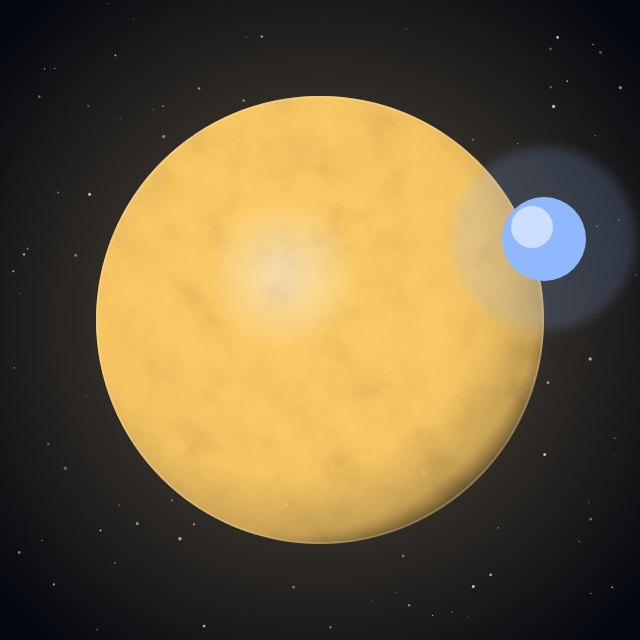
Stars· Distance ~430 ly · the sky's loveliest double. The star at the Swan's beak. Through a small telescope it splits into a golden star and a blue one side by side — often called the most beautiful double in the sky. Whether the two are truly bound is still debated, but the colour contrast is unforgettable.
📍 Visible from where you are right now — computed in your browser
bearing · altitude · rise time · best time tonight
Where Albireo is in your sky right now: https://nowsky.org/solar/sky?sel=albireo — location and time set automatically, no login.
Distance and spectral type
Albireo is about 434 light-years away, a orange bright giant (spectral type K3II+...), in the constellation Cygnus. Its apparent magnitude is 3.1, visible to the naked eye.
Stellar figures
| Distance | ~430 ly |
|---|---|
| Magnitude | 3.1 (combined) |
| Colours | golden giant + blue companion |
| Constellation | Cygnus |
Figures are representative approximations. Source: compiled from NASA and IAU public data.
Frequently asked
- How far is Albireo from Earth?
- ~430 ly.
- How bright is Albireo (apparent magnitude)?
- 3.1 (combined).
- Which constellation is Albireo in?
- Cygnus.
- Where is Albireo in the sky right now?
- Open the sky view for your location and time and it shows the position in the sky right now.
A blue star that looks green — the contrast illusion
Albireo's two stars are described as gold and blue, yet many observers see the smaller one as green. Its true colour is blue-white (spectral type B8). Set beside a bright orange star, the eye leans toward the complementary hue and reads blue as green — the same illusion that makes Antares B look green. View the two separately and the green vanishes.
Stars cannot truly be green. Starlight forms a continuous spectrum running from red through white to blue with temperature, and a star whose output peaks in green (the Sun is one) looks white because the other colours mix in. So a "green star" is always the product of contrast with a red neighbour. Albireo shows that illusion more beautifully than any other pair, which is why it never drops off the list of double stars to observe.
The star in depth
Albireo marks the head of Cygnus, the tip of the Swan's beak. To the eye it is an ordinary third-magnitude star, but a telescope transforms it: a bright golden-orange giant and a crisp blue-white companion sit 35 arcseconds apart. The contrast is so vivid that Albireo is the standard demonstration that a star's colour reveals its temperature.
Whether the pair is a true binary or a chance alignment has been argued for decades. Gaia's precise measurements show slightly different distances and motions, tilting the odds toward an optical double, but the question is not settled. The brighter component, Albireo A, is itself a tight binary that no telescope can split.
On summer nights follow the Swan's neck down from Deneb, inside the Summer Triangle, and you reach Albireo at the beak. Select it in the Sky view to highlight the Swan's long body and learn its place. In real skies the two colours show in a small telescope at low power, which is why it is a star-party favourite.
Related
Figures are representative approximations. Simulated positions use J2000 mean elements.