SGR 1806−20
What is SGR 1806−20?
Neutron stars & pulsars· Distance ~50,000 ly. A magnetic star a thousand trillion times stronger than Earth's field. On 27 December 2004 it released, in 0.2 seconds, as much energy as the Sun emits in more than 100,000 years — enough to disturb Earth's ionosphere from 50,000 light-years away. It lies toward Sagittarius, beyond the galactic center.
📍 Visible from where you are right now — computed in your browser
bearing · altitude · rise time · best time tonight
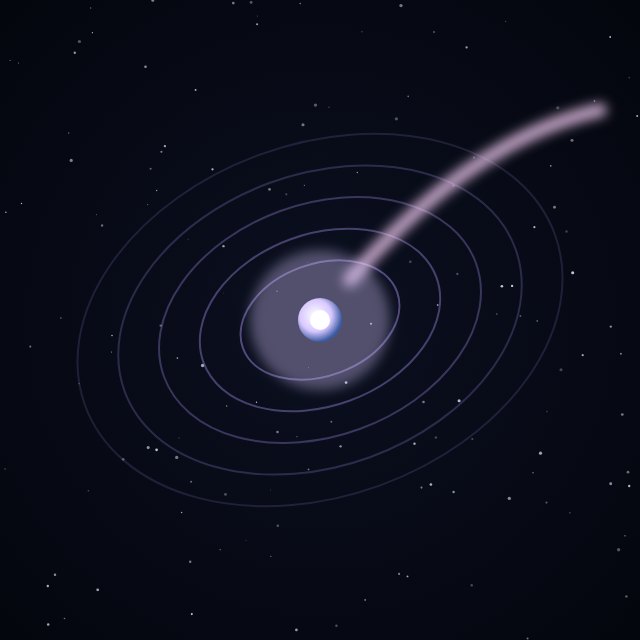
Where SGR 1806−20 is in your sky right now: https://nowsky.org/solar/sky?sel=sgr 1806 — location and time set automatically, no login.
Its place in the sky
A magnetar, in the direction of Sagittarius.
Spin, distance, discovery
| Type | magnetar, a soft gamma repeater |
|---|---|
| Spin period | 7.5 s |
| Magnetic field | ~10¹⁵ gauss, among the strongest known |
| Distance | ~50,000 ly, across the galaxy |
| Discovered | found 1979 by its gamma-ray bursts; giant flare on 27 Dec 2004 |
Figures are representative approximations. Source: compiled from NASA and IAU public data.
Discovery and name
In Dec 2004 its giant flare rattled Earth's ionosphere from 50,000 ly — the most powerful burst ever seen from within the galaxy.
Frequently asked
- What kind of object is SGR 1806−20?
- magnetar, a soft gamma repeater.
- How long is the orbital period of SGR 1806−20?
- 7.5 s.
- How far is SGR 1806−20 from Earth?
- ~50,000 ly, across the galaxy.
- When was SGR 1806−20 discovered?
- found 1979 by its gamma-ray bursts; giant flare on 27 Dec 2004.
- Where in the sky is SGR 1806−20?
- In the direction of Sagittarius.
- Where is SGR 1806−20 in the sky right now?
- Open the sky view for your location and time and it shows the position in the sky right now.
A magnetar born in a cluster of giant stars
SGR 1806-20 is not alone. The magnetar sits inside a young cluster that includes LBV 1806-20, one of the brightest stars in the Milky Way, along with Wolf–Rayet stars and supergiants. Since the cluster's stars are massive, tens of solar masses each, the star that became the magnetar is inferred to have been equally heavy. Stars of that mass were expected to leave black holes, so a heavy progenitor for a magnetar forced revisions to theories of how stars end.
At 50,000 light-years on the far side of the galaxy the cluster is hidden by dust, invisible in ordinary light and observed only in infrared. Neighbouring LBV 1806-20 is estimated at millions of times the Sun's luminosity, though whether that light belongs to one star or a binary is unsettled. The outburst that rattled Earth's ionosphere in 2004 was left by the first of these giants to die.
The neutron star in depth
SGR 1806-20 is a magnetar — a neutron star whose magnetic field, around 10¹⁵ gauss, is a thousand times that of an ordinary pulsar and a thousand trillion times Earth's. It sits about 50,000 light-years away toward Sagittarius, beyond the galactic center, turning once every 7.5 seconds. In such stars the field itself twists and cracks the crust, triggering repeated gamma-ray outbursts, which is why it is classed as a soft gamma repeater.
On 27 December 2004 it produced the most powerful stellar outburst on record: in just 0.2 seconds it released as much energy in gamma rays as the Sun emits in more than 100,000 years. After crossing 50,000 light-years, that flash ionized Earth's upper atmosphere, disturbed radio communications and saturated detectors on several satellites. Had the star been within 10 light-years, calculations suggest the flare could have stripped the ozone layer and caused a mass extinction.
Select SGR 1806-20 in the Sky view to see where it hides behind the dense star clouds of the Milky Way's core in Sagittarius. All the eye can see is the glow of the galaxy, but knowing that a magnetic star 50,000 light-years beyond once shook Earth's atmosphere adds a chill to finding Sagittarius in the southern summer sky.
Related
Figures are representative approximations. Simulated positions use J2000 mean elements.