Cygnus X-1
What is Cygnus X-1?
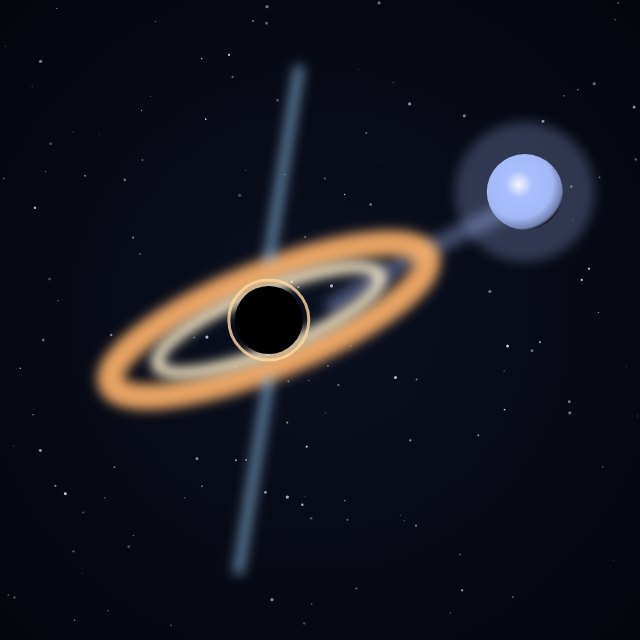
Black holes & quasars· Distance 7,200 ly. The first object astronomers accepted as a real black hole. An invisible companion orbits a blue supergiant in Cygnus every 5.6 days, pulling in gas that blazes in X-rays. Hawking and Thorne famously bet on its nature in 1974; Hawking conceded in 1990.
📍 Visible from where you are right now — computed in your browser
bearing · altitude · rise time · best time tonight
Where Cygnus X-1 is in your sky right now: https://nowsky.org/solar/sky?sel=cygnus x-1 — location and time set automatically, no login.
Its place in the sky
A black hole, in the direction of Cygnus.
Mass, distance, nature
| Mass | ~21 Suns |
|---|---|
| Distance | ~7,200 ly |
| Companion | blue supergiant, 5.6-day orbit |
| Discovered | 1964, rocket-borne X-ray survey |
Figures are representative approximations. Source: compiled from NASA and IAU public data.
Discovery and name
Found by a rocket flight in 1964. Hawking bet Thorne it was not a black hole — and conceded in 1990.
Frequently asked
- What is the mass of Cygnus X-1?
- ~21 Suns.
- How far is Cygnus X-1 from Earth?
- ~7,200 ly.
- When was Cygnus X-1 discovered?
- 1964, rocket-borne X-ray survey.
- Where in the sky is Cygnus X-1?
- In the direction of Cygnus.
- Where is Cygnus X-1 in the sky right now?
- Open the sky view for your location and time and it shows the position in the sky right now.
In 2021 the distance grew, and so did the mass
The black hole in Cygnus X-1 was long put at 15 solar masses. When a very-long-baseline radio array remeasured the distance by parallax in 2021, it came out at 7,200 light-years, 20 percent farther than before; a greater distance means the companion must be brighter and heavier, the calculation cascaded, and the black hole's mass rose to 21 Suns. That is heavy for a black hole left by a single star, and the conclusion followed that massive stars lose less mass in their winds before dying than had been assumed.
The system's spin has been measured too. Reading from the X-ray spectrum how far in the inner edge of the accretion disk reaches gives the rotation, and Cygnus X-1 was judged to spin close to the theoretical maximum. The first black-hole candidate, found by a rocket flight in 1964, still serves sixty years on as the reference specimen for spin and mass.
The black hole in depth
Cygnus X-1 was found in 1964 by an X-ray detector riding a sounding rocket, and it remains one of the strongest X-ray sources in the sky. Radio and optical work in 1971 tied it to the ninth-magnitude blue supergiant HDE 226868, and the wobble of that star implied an unseen partner far heavier than any neutron star could be. A precise distance measurement in 2021 raised its mass to about 21 Suns.
The object is also famous for a wager. In 1974 Stephen Hawking bet that Cygnus X-1 was not a black hole, while Kip Thorne bet that it was; Hawking joked the bet was insurance in case his life's work on black holes proved wasted. As the evidence mounted he dropped by Thorne's office in 1990 and signed his concession.
The companion star sits near Eta Cygni in the thick of the summer Milky Way and is an easy binocular target, though the black hole itself shows only to X-ray telescopes. Select Cygnus X-1 in the Sky view to see its spot along the swan's neck below Deneb, then put its 120-kilometre event horizon beside a city on the size ladder.
Related
Figures are representative approximations. Simulated positions use J2000 mean elements.